MinuteRead
30 min
Book summary
by Vitaliy N. Katsenelson
Premium summary · Opens in the app · 30 min read
Every generation of investors carries assumptions shaped by the market environment they first encountered. If you began investing in the 1980s or 1990s, you learned that stocks always recover. You learned that patience is rewarded. You learned that the market, given enough time, delivers generous returns to anyone willing to stay invested.
**Author:** Vitaliy N. Katsenelson
**Estimated Reading Time:** 45 minutes
**What You'll Learn:**
* Why the stock market's behavior changed dramatically after 2000 * How to identify the difference between bull markets and sideways markets * The Quality, Valuation, and Growth framework for stock selection * Why sell discipline matters more than buy discipline * How to use volatility as an ally instead of fearing it * The role of global economic forces in shaping market cycles * A complete system for active value investing in challenging markets
**Who This Book Is For:**
This book is for individual investors who have grown frustrated with the traditional buy-and-hold advice that worked for their parents but has failed them. It is for anyone who has watched their portfolio stagnate for years despite following conventional wisdom. It is for readers who sense that something fundamental has shifted in the financial markets and want a clear framework for navigating the new reality.
Every generation of investors carries assumptions shaped by the market environment they first encountered. If you began investing in the 1980s or 1990s, you learned that stocks always recover. You learned that patience is rewarded. You learned that the market, given enough time, delivers generous returns to anyone willing to stay invested. Those lessons were true. But they were true for a specific era. The stock market does not move in one continuous upward trajectory. It moves in long cycles that span decades. There are periods when the market climbs relentlessly, creating the illusion that wealth accumulation through stocks is almost effortless. Then there are periods when the market goes nowhere for years, frustrating investors who expect the old rules to keep working. The American stock market entered one of those frustrating periods in the year 2000. After the greatest bull market in history, the market shifted into a sideways pattern that has confounded millions of investors. The Dow Jones Industrial Average, which stood at 11,722 in January 2000, was still hovering around the same level a decade later. Investors who bought and held through this period saw their portfolios go nowhere. This is not an anomaly. It is a recurring feature of market history. The problem is that most investment advice was written during bull markets. The strategies that dominate popular financial media, the assumptions baked into retirement planning calculators, and the instincts of most professional money managers all stem from an era when the market rewarded passivity. In a sideways market, those same instincts become liabilities. Vitaliy Katsenelson wrote this book to address a simple but urgent question: How should investors behave when the market stops going up? His answer is not comforting in the conventional sense. He does not promise…
Continue reading in the MinuteRead app
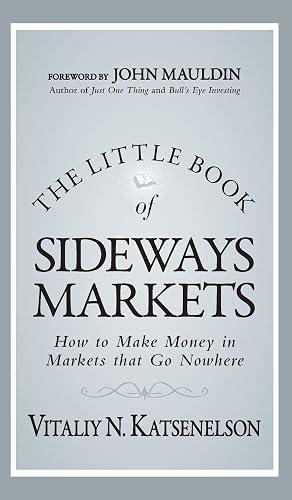
Get the complete 30-minute summary of The Little Book of Sideways Markets
Get the complete summary in the appThe stock market is in a sideways cycle that began in 2000 and may last for years.
In sideways markets, P/E contraction offsets earnings growth, leaving stock prices flat.
Buy-and-hold strategies that worked in bull markets fail in sideways markets.
Use the QVG framework: focus on quality, valuation, and growth.
Never compromise on more than one QVG factor.
Create a prenuptial agreement for every stock you buy.
"The Little Book of Sideways Markets" is a strong fit if you want practical ideas around finance, business, economics, especially themes like the stock market is in a sideways cycle that began in 2000 and may last for years; in sideways markets, p/e contraction offsets earnings growth, leaving stock prices flat. The MinuteRead summary distills these concepts into a focused read, whether you're deciding whether to buy the book or applying its lessons at work.
Motivated to help readers with welcome to the sideways market! Market cycles evolve, Vitaliy N. Katsenelson wrote “The Little Book of Sideways Markets” to package those ideas for a fast, focused read. In “The Little Book of Sideways Markets”, Vitaliy N. Katsenelson focuses on welcome to the sideways market! Market cycles evolve. Through “The Little Book of Sideways Markets”, Vitaliy N. Katsenelson distills the core ideas on finance into lessons readers can absorb in a single short sitting. Reade…
Continue Reading
Access the complete 30-minute summary and thousands more nonfiction books in the MinuteRead app.

Continue reading the complete summary in the MinuteRead app.