MinuteRead
30 min
Book summary
Premium summary · Opens in the app · 30 min read
Every day, millions of people make financial decisions without knowing what anything is actually worth. They buy stocks because a friend recommended them. They sell in a panic because the market dropped. They hold onto failing investments because selling would mean admitting a mistake. They chase companies with compelling stories but no profits, and they avoid solid businesses because the headlines look bleak.
**Author:** Aswath Damodaran
**Estimated Reading Time:** 45 minutes
**What You'll Learn:**
- How to value any company using the core tools of intrinsic and relative valuation - Why the story behind the numbers matters more than the numbers themselves - How to adapt valuation techniques for young, mature, declining, cyclical, and financial service companies - The common biases that distort valuations and how to guard against them - Practical frameworks you can apply immediately to make better investment decisions
**Who This Book Is For:**
Investors who want to move beyond stock tips and headlines. Analysts who need a reliable framework for thinking about value. Business owners who want to understand what drives the worth of their enterprise. Students of finance who need clarity amid competing methodologies. And anyone who has ever wondered whether a company is truly worth what the market says it is.
Every day, millions of people make financial decisions without knowing what anything is actually worth. They buy stocks because a friend recommended them. They sell in a panic because the market dropped. They hold onto failing investments because selling would mean admitting a mistake. They chase companies with compelling stories but no profits, and they avoid solid businesses because the headlines look bleak. This is not investing. It is guessing. The alternative is valuation. Valuation is the process of estimating what an asset is worth, whether that asset is a share of Apple, a small manufacturing business, or a piece of real estate. It sounds intimidating, and the finance industry has done its best to make it seem that way. Walk into any investment bank and you will hear talk of stochastic processes, Monte Carlo simulations, and complex mathematical models that require advanced degrees to understand. But here is the secret that the finance industry would prefer you not know: the simplest tools in finance are often the most powerful. You do not need a PhD in mathematics to value a company. You do not need access to proprietary data or expensive software. You need a clear framework, an understanding of a few fundamental concepts, and the discipline to apply them consistently. Aswath Damodaran has spent decades teaching valuation to MBA students at New York University's Stern School of Business. He has written some of the most comprehensive textbooks on the subject, the kind that run to a thousand pages and sit on the shelves of serious finance professionals. But he has also learned something important through those years of teaching: the core ideas of valuation can be communicated simply. The essence of the discipline fits in a small book. That is what this book is. It is not a simplified version of valuation that cuts…
Continue reading in the MinuteRead app
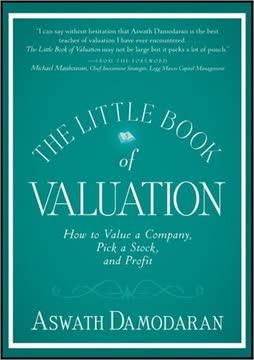
Get the complete 30-minute summary of The Little Book of Valuation
Get the complete summary in the app**A company is worth the present value of its future cash flows.** This is the foundation of all valuation.
**All valuations are biased.** Acknowledge your biases and be transparent about your assumptions.
**Cash flows, growth, and risk are the three drivers of value.** Every valuation ultimately depends on these factors.
**Small changes in assumptions produce large changes in value.** Embrace uncertainty rather than pretending it does not
**Multiples are easy to misuse.** Understand what drives them before using them.
**Young companies require adjusting for the probability of failure.** Many do not survive.
"The Little Book of Valuation" is a strong fit if you want practical ideas around finance, business, economics, especially themes like **a company is worth the present value of its future cash flows.** this is the foundation of all valuation; **all valuations are biased.** acknowledge your biases and be transparent about your assumptions. The MinuteRead summary distills these concepts into a focused read, whether you're deciding whether to buy the book or applying its lessons at work.
Aswath Damodaran is a renowned finance expert and professor at New York University's Stern School of Business. He holds the Kerschner Family Chair in Finance Education and teaches corporate finance and equity valuation. Damodaran is widely recognized for his contributions to the field of valuation and has authored numerous influential academic and practitioner texts on Valuation, Corporate Finance, and Investment Management. His expertise and publications have made him a respected figure in both…
View all summaries by Aswath DamodaranContinue Reading
Access the complete 30-minute summary and thousands more nonfiction books in the MinuteRead app.

Continue reading the complete summary in the MinuteRead app.