MinuteRead
30 min
Book summary
Premium summary · Opens in the app · 30 min read
Imagine you are standing in a supermarket aisle, staring at two boxes of cereal. One box costs four dollars. The other box, identical in every way, costs two dollars. The choice is obvious. You buy the two-dollar box and feel good about it. Now imagine walking into that same supermarket tomorrow and finding that the two-dollar box now costs three dollars. The next day it costs one dollar. The day after that, four dollars. The cereal itself has not changed. The box is the same. The contents are t
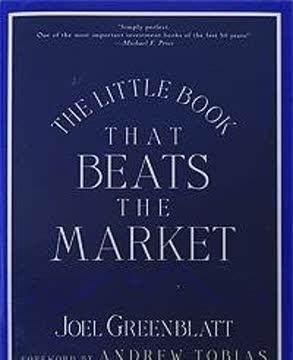
**Author:** Joel Greenblatt
**Estimated Reading Time:** 45 minutes
**What You'll Learn:** - A simple, proven formula for identifying good companies at bargain prices - Why most investors fail despite having access to endless information - How to build a portfolio that has historically beaten the market by a wide margin - The psychological discipline required to stick with a winning strategy - How to apply these principles to your own investing, regardless of experience
**Who This Book Is For:** This book is for anyone who wants to take control of their financial future. Whether you are a complete beginner who has never bought a stock or a seasoned investor frustrated by mediocre results, the ideas here will give you a clear, actionable framework. It is written for people who want to understand not just what to do, but why it works. If you have ever felt confused by the stock market, overwhelmed by financial jargon, or skeptical of the advice coming from Wall Street, this book was written for you.
Imagine you are standing in a supermarket aisle, staring at two boxes of cereal. One box costs four dollars. The other box, identical in every way, costs two dollars. The choice is obvious. You buy the two-dollar box and feel good about it. Now imagine walking into that same supermarket tomorrow and finding that the two-dollar box now costs three dollars. The next day it costs one dollar. The day after that, four dollars. The cereal itself has not changed. The box is the same. The contents are the same. Only the price is different. This is the stock market. Every day, millions of people buy and sell pieces of real businesses at prices that fluctuate wildly. Sometimes those prices make sense. Often they do not. The question is not whether the market is rational, because it frequently is not. The question is whether you can use that irrationality to your advantage. Joel Greenblatt believes you can. And he does not ask you to take his word on faith. He shows you, with decades of data and a disarmingly simple formula, how buying good businesses at bargain prices has produced extraordinary returns over time. The problem is that most people approach investing the wrong way. They watch financial news. They listen to stock tips from friends. They chase companies with exciting stories. They buy mutual funds with impressive recent performance. They pay professionals to make decisions for them. And in the end, most of them underperform the market, sometimes dramatically. Why does this happen? Because the financial industry is not designed to make you rich. It is designed to make itself rich. Brokers earn commissions when you trade. Fund managers…
Continue reading in the MinuteRead app
Get the complete 30-minute summary of The Little Book That Beats the Market
Get the complete summary in the appBuy good companies at bargain prices.
Return on capital measures business quality.
Earnings yield measures bargain price.
The magic formula combines both factors into a single ranking.
The formula beat the market in 95 percent of three-year periods.
Underperformance is normal and expected.
"The Little Book That Beats the Market" is a strong fit if you want practical ideas around finance, business, money, especially themes like buy good companies at bargain prices; return on capital measures business quality. The MinuteRead summary distills these concepts into a focused read, whether you're deciding whether to buy the book or applying its lessons at work.
Joel Greenblatt is a prominent figure in the financial world, known for his work as a hedge fund manager, academic, and author. As the founder of Gotham Capital and an adjunct professor at Columbia University Graduate School of Business, Greenblatt has made significant contributions to the field of investing. His expertise extends beyond managing funds, as he has also served as the chairman of Alliant Techsystems and founded the New York Securities Auction Corporation. Greenblatt's diverse exper…
View all summaries by Joel GreenblattContinue Reading
Access the complete 30-minute summary and thousands more nonfiction books in the MinuteRead app.

Continue reading the complete summary in the MinuteRead app.