MinuteRead
30 min
Book summary
by Benoît B. Mandelbrot
Premium summary · Opens in the app · 30 min read
In 1998, a hedge fund called Long-Term Capital Management collapsed. The fund had been founded by some of the brightest minds in finance, including two Nobel laureates whose work on options pricing had revolutionized Wall Street. Their models were elegant, mathematically sophisticated, and widely admired. According to those models, the losses that brought down the fund should have been impossible, events so rare they might occur once in the lifetime of the universe.
**Author:** Benoît B. Mandelbrot
**Estimated Reading Time:** 45 minutes
**What You'll Learn:**
- Why the financial models you trust are built on sand - How fractal geometry reveals the true structure of market risk - Why extreme events happen far more often than anyone admits - What turbulence in nature can teach us about turbulence in markets - How to think differently about investing, risk, and uncertainty
**Who This Book Is For:**
Anyone who has ever wondered why financial markets behave so wildly, why experts so often get things wrong, and what a more honest approach to understanding money might look like. This book is for investors, students of finance, and curious readers who sense that something is deeply wrong with the way we think about risk.
In 1998, a hedge fund called Long-Term Capital Management collapsed. The fund had been founded by some of the brightest minds in finance, including two Nobel laureates whose work on options pricing had revolutionized Wall Street. Their models were elegant, mathematically sophisticated, and widely admired. According to those models, the losses that brought down the fund should have been impossible, events so rare they might occur once in the lifetime of the universe. Yet they happened. This is not an isolated story. In 1987, the Dow Jones Industrial Average fell more than 22 percent in a single day. According to standard financial theory, such a move was a statistical impossibility, a once-in-a-billion-years event. In 2008, the global financial system nearly collapsed because risk models failed to anticipate that housing prices could fall across the entire country simultaneously. Something is deeply wrong with how we understand financial markets. Benoît Mandelbrot spent his career studying irregular patterns in nature. He coined the word "fractal" to describe shapes that repeat themselves at different scales, from coastlines to clouds to the branching of trees. When he turned his attention to financial markets, he saw the same patterns he had observed in nature: wild turbulence, sudden discontinuities, and a kind of structured chaos that defied conventional mathematics. The problem, Mandelbrot argued, is not that markets are irrational. The problem is that our models are inadequate. We have tried to force the messy reality of financial markets into the neat framework of classical statistics, and the result has been a dangerous illusion of control. The standard model of finance rests on several assumptions. It assumes that price changes are independent, like coin flips. It assumes that they follow a normal distribution, the familiar bell curve. It assumes that markets are efficient, that prices reflect all available information, and that investors behave rationally. These assumptions make the mathematics tractable, but they have little to do with reality. Mandelbrot's alternative vision…
Continue reading in the MinuteRead app
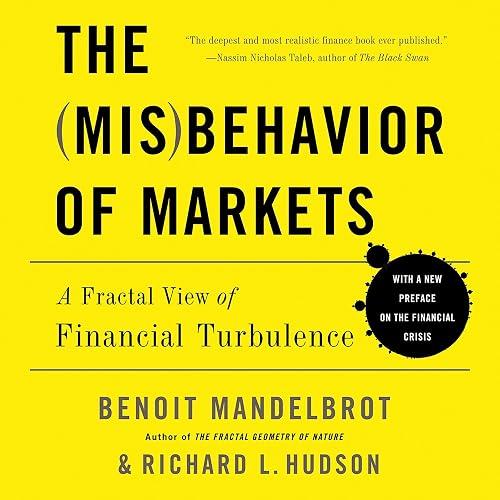
Get the complete 30-minute summary of The (Mis) Behavior of Markets
Get the complete summary in the appMarkets are turbulent and unpredictable, like flowing water or moving air.
The bell curve does not fit financial data. Extreme events are far more common than it predicts.
Price changes are discontinuous. They jump and skip rather than moving smoothly.
Markets have long-term memory. The past influences the present in ways standard models ignore.
A few days account for most market gains and losses. Timing matters enormously.
Volatility clusters. Calm periods alternate with turbulence.
"The (Mis) Behavior of Markets" is a strong fit if you want practical ideas around finance, economics, business, especially themes like markets are turbulent and unpredictable, like flowing water or moving air; the bell curve does not fit financial data. extreme events are far more common than it predicts. The MinuteRead summary distills these concepts into a focused read, whether you're deciding whether to buy the book or applying its lessons at work.
Motivated to help readers with 1) Markets Are Fundamentally Turbulent and Unpredictable 2) Financial Risk Is Far Greater Than Traditional, Benoît B. Mandelbrot wrote “The (Mis) Behavior of Markets” to package those ideas for a fast, focused read. In “The (Mis) Behavior of Markets”, Benoît B. Mandelbrot focuses on 1) Markets Are Fundamentally Turbulent and Unpredictable 2) Financial Risk Is Far Greater Than Traditional. Through “The (Mis) Behavior of Markets”, Benoît B. Mandelbrot distills the co…
Continue Reading
Access the complete 30-minute summary and thousands more nonfiction books in the MinuteRead app.

Continue reading the complete summary in the MinuteRead app.