MinuteRead
30 min
Book summary
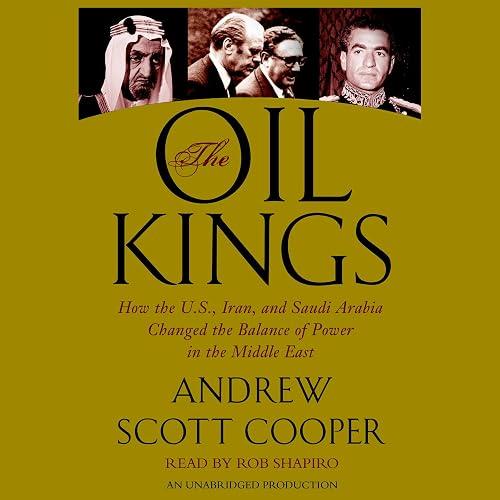
by Andrew Scott Cooper
Premium summary · Opens in the app · 30 min read
In October 1973, the world changed. Arab oil producers announced an embargo against nations supporting Israel in the Yom Kippur War. Within months, the price of crude oil quadrupled. Gas stations across America ran dry. Drivers waited in lines that stretched for blocks. The industrial economies of the West, built on the assumption of cheap and abundant energy, suddenly faced a future they had never imagined.
**Author:** Andrew Scott Cooper
**Estimated Reading Time:** 45 minutes
**What You'll Learn:**
How a handful of oil-producing nations fundamentally reshaped the global economic order in the 1970s, how secret diplomacy between Washington and Tehran created a dangerous dependency, and why the decisions made during this pivotal decade continue to echo through international relations today.
**Who This Book Is For:**
Readers who want to understand the hidden history of the 1970s oil crisis, the real relationship between the United States and the Shah of Iran, and the origins of tensions that still define Middle Eastern geopolitics.
In October 1973, the world changed. Arab oil producers announced an embargo against nations supporting Israel in the Yom Kippur War. Within months, the price of crude oil quadrupled. Gas stations across America ran dry. Drivers waited in lines that stretched for blocks. The industrial economies of the West, built on the assumption of cheap and abundant energy, suddenly faced a future they had never imagined. But the story of the oil shock is not simply a story about economics. It is a story about power: who holds it, how it is wielded, and what happens when the balance shifts. Andrew Scott Cooper's "The Oil Kings" reveals that the crisis of the 1970s was not an accident of history. It was the result of deliberate decisions made by a small group of leaders who saw an opportunity to reshape the world order. At the center of this story stands the Shah of Iran, Mohammad Reza Pahlavi. To American policymakers, he appeared to be a loyal ally, a stabilizing force in a volatile region. Richard Nixon and Henry Kissinger viewed him as a partner who could protect American interests in the Persian Gulf. They gave him unprecedented access to American weapons. They looked the other way when he pushed for higher oil prices. They treated him as a surrogate for American power. But the Shah had his own ambitions. He did not want to be America's proxy. He wanted to make Iran a great power in its own right. He used oil revenues to build a military machine that rivaled any in the region. He invested in nuclear technology. He dreamed of turning Iran into a modern industrial state by 1980. And he believed that the United States needed him more than he needed the United States. The relationship between Washington and Tehran in the 1970s was built on a foundation of mutual misunderstanding. American officials assumed that the Shah shared their strategic vision. The Shah assumed that American support was unconditional. Both assumptions proved disastrous. The oil shock exposed the fragility of the global financial system. Suddenly, enormous sums of money flowed from oil-consuming nations…
Continue reading in the MinuteRead app
Get the complete 30-minute summary of The Oil Kings
Get the complete summary in the appThe oil shock was a deliberate political strategy, not a natural market event.
The US-Iran alliance was built on convenience, not shared values.
Nixon gave the Shah a blank check for weapons, creating a dangerous dependency.
The Shah's military buildup was driven by prestige, not security needs.
Petrodollar recycling kept the global economy functioning but was inherently fragile.
The decline of American influence was largely self-inflicted.
"The Oil Kings" is a strong fit if you want practical ideas around history, politics, economics, especially themes like the oil shock was a deliberate political strategy, not a natural market event; the us-iran alliance was built on convenience, not shared values. The MinuteRead summary distills these concepts into a focused read, whether you're deciding whether to buy the book or applying its lessons at work.
Motivated to help readers with Henry Kissinger, the 1970s oil embargo, and the Iranian Revolution, Andrew Scott Cooper wrote “The Oil Kings” as a practical guide drawn from years of experience and research. In “The Oil Kings”, Andrew Scott Cooper focuses on "The quadrupling of the price of this key resource in such a short time has created widespread distortions. Through “The Oil Kings”, Andrew Scott Cooper distills the core ideas on history into lessons readers can absorb in a single short sitt…
Continue Reading
Access the complete 30-minute summary and thousands more nonfiction books in the MinuteRead app.

Continue reading the complete summary in the MinuteRead app.