MinuteRead
30 min
Book summary
by Robert Fritz
Premium summary · Opens in the app · 30 min read
Most people spend their lives trying to change their behavior. They read books about habits, attend seminars on motivation, download apps that track their progress, and make sincere promises to themselves about how things will be different this time. And yet, for most people, things do not become different. The weight comes back. The savings account stays empty. The relationship falls into the same arguments. The career remains a source of quiet frustration.
**Author:** Robert Fritz
**Estimated Reading Time:** 45 minutes
**What You'll Learn:**
- Why most self-improvement efforts fail despite genuine effort - The hidden structures that determine the direction of your life - How to shift from solving problems to creating results - The exact mechanism that turns vision into reality - How to make choices that reorganize your entire life
**Who This Book Is For:**
Anyone who has ever made a New Year's resolution that didn't stick, started a diet that ended in backsliding, launched a project that stalled, or felt stuck in patterns they couldn't explain. This book is for people who sense they are capable of more but keep finding themselves pulled back to where they started.
Most people spend their lives trying to change their behavior. They read books about habits, attend seminars on motivation, download apps that track their progress, and make sincere promises to themselves about how things will be different this time. And yet, for most people, things do not become different. The weight comes back. The savings account stays empty. The relationship falls into the same arguments. The career remains a source of quiet frustration. Why does this happen? Are people simply weak? Do they lack discipline? Is there something fundamentally broken about human nature that makes lasting change nearly impossible? Robert Fritz offers a radically different explanation. The problem is not your character, your willpower, or your commitment. The problem is the structure of your life. Consider how water flows through a landscape. It always follows the path of least resistance. If you pour water over uneven ground, it will find the channels, the grooves, the natural depressions, and it will flow through them every single time. You can stand at the edge and shout at the water, beg it to flow uphill, lecture it about the importance of reaching higher ground. None of this matters. The water follows the structure of the terrain. Your life works the same way. You have underlying structures: your beliefs, assumptions, desires, habits of thought, and ways of relating to circumstances. These structures determine the path of least resistance in your life. When you try to change your behavior without changing these structures, you are asking water to flow uphill. It might work for a moment through sheer force, but the moment you tire, the water returns to its old channel. This explains the universal experience of backsliding. The dieter loses thirty pounds and gains forty. The organization launches a change initiative and slides back into old patterns within eighteen months. The couple goes to therapy, improves for a while, then falls back into the same destructive cycle. In every case, the underlying structure remained unchanged.…
Continue reading in the MinuteRead app
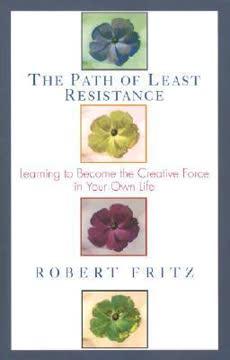
Get the complete 30-minute summary of The Path of Least Resistance
Get the complete summary in the appYour life is governed by structures that determine the path of least resistance.
To change your life, change the underlying structure, not just your behavior.
Structural conflict produces oscillation: progress followed by backsliding.
Creating and problem solving are fundamentally different. Creating brings something into being.
Structural tension is the engine of creation. It arises from holding vision and reality simultaneously.
You do not discover what you want. You invent it.
"The Path of Least Resistance" is a strong fit if you want practical ideas around self help, business, personal development, especially themes like your life is governed by structures that determine the path of least resistance; to change your life, change the underlying structure, not just your behavior. The MinuteRead summary distills these concepts into a focused read, whether you're deciding whether to buy the book or applying its lessons at work.
Robert Fritz is an author, composer, and management consultant known for his work on structural dynamics and the creative process. He developed the concept of "structural tension" as a key to personal and organizational creativity. Fritz has written several books on creativity and personal development, with "The Path of Least Resistance" being his most well-known work. He founded DMA, Inc., a consulting firm that applies his principles to business and leadership. Fritz's background in music and …
View all summaries by Robert FritzContinue Reading
Access the complete 30-minute summary and thousands more nonfiction books in the MinuteRead app.

Continue reading the complete summary in the MinuteRead app.