MinuteRead
30 min
In the early 1960s, a mathematics professor from California walked into a Las Vegas casino with a plan. Ed Thorp had spent months analyzing the game of blackjack, using an IBM computer to calculate the odds of every possible card combination. He had discovered something remarkable: the game was not purely random. By tracking which cards had already been played, a skilled observer could gain a measurable edge over the house.
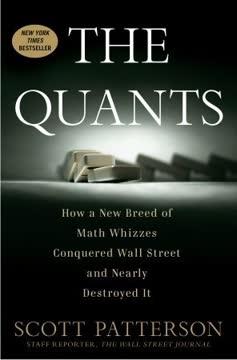
**Author:** Scott Patterson
**Estimated Reading Time:** 45 minutes
**What You'll Learn:**
- How mathematicians and scientists conquered Wall Street - The true story behind the rise of quantitative trading - Why brilliant models failed catastrophically in 2007 and 2008 - The hidden risks that nearly destroyed the global financial system - What the quant revolution means for every investor today
**Who This Book Is For:**
This book is for anyone who wants to understand how Wall Street really works in the modern era. If you have ever wondered why markets behave irrationally, how a handful of mathematicians came to dominate global finance, or what really caused the 2008 financial crisis, this book will give you the answers. It is written for curious investors, students of finance, and anyone fascinated by the intersection of genius, money, and risk.
In the early 1960s, a mathematics professor from California walked into a Las Vegas casino with a plan. Ed Thorp had spent months analyzing the game of blackjack, using an IBM computer to calculate the odds of every possible card combination. He had discovered something remarkable: the game was not purely random. By tracking which cards had already been played, a skilled observer could gain a measurable edge over the house. Thorp won. He won consistently. And then he wrote a book about it. That book, *Beat the Dealer*, became a sensation. It proved something that most people believed was impossible: mathematics could beat a game designed to be unbeatable. But Thorp was just getting started. He soon turned his attention to a much bigger game, one with far higher stakes than any casino table. He turned to Wall Street. What Thorp started would eventually transform the entire financial system. Over the next five decades, a new breed of trader emerged. They were not the cigar-chomping, gut-instinct stock pickers of Wall Street legend. They were mathematicians, physicists, computer scientists, and engineers. They built algorithms that could analyze millions of data points in milliseconds. They created models that could predict market movements with uncanny accuracy. They believed that investing was not an art but a science, and that the right equations could unlock unlimited wealth. They called themselves quants. For a while, it seemed like they were right. Quantitative hedge funds like Renaissance Technologies, Citadel, and AQR Capital generated returns that seemed to defy the laws of finance. Jim Simons, a former codebreaker and mathematics professor, built Renaissance's Medallion fund into the most successful investment vehicle in history, delivering annual returns of roughly 40 percent for three decades. Ken Griffin started trading convertible bonds from his Harvard dorm room and built Citadel into a multi-billion-dollar empire. Cliff Asness, a former student of Nobel Prize-winning…
Continue reading in the MinuteRead app
Get the complete 30-minute summary of The Quants
Get the complete summary in the appAlpha is the edge. Beta is just the market. The quants chased alpha.
Ed Thorp proved that mathematics could beat blackjack, then applied the same principles to Wall Street.
Renaissance Technologies' Medallion fund is the most successful hedge fund in history, with annual returns of roughly 40
In August 2007, quant strategies suddenly failed because crowded trades unwound simultaneously.
In 2008, leverage and model failure devastated prominent quant funds like Citadel and AQR.
Models are backward-looking. They cannot predict unprecedented events.
"The Quants" is a strong fit if you want practical ideas around finance, business, economics, especially themes like alpha is the edge. beta is just the market. the quants chased alpha; ed thorp proved that mathematics could beat blackjack, then applied the same principles to wall street. The MinuteRead summary distills these concepts into a focused read, whether you're deciding whether to buy the book or applying its lessons at work.
Scott Patterson is a journalist and author known for his work on financial markets and regulation. He wrote the New York Times bestseller "The Quants" and another book called "Dark Pools." Patterson is a reporter for The Wall Street Journal, covering financial regulation from Washington, D.C. He has also contributed to other major publications such as the New York Times and Rolling Stone. With a master's degree from James Madison University, Patterson brings his expertise in financial journalism…
View all summaries by Scott PattersonContinue Reading
Access the complete 30-minute summary and thousands more nonfiction books in the MinuteRead app.

Continue reading the complete summary in the MinuteRead app.