 MinuteRead
30 min
Book summary
Premium summary · Opens in the app · 30 min read
“ For a goal to be effective, it needs to be a hot knife… ripping your entire business to shreds, leaving only the most relevant and scalable signal.
**Author:** Benjamin Hardy
**Estimated Reading Time:** 42 minutes
**What You'll Learn:**
- Why attainable goals are silently killing your business - How to use impossible goals as strategic filters - The three-part framework that separates companies that scale from those that stall - How to identify and solve the single constraint holding everything back - Why radical honesty is the price of admission to growth - How to build a business that scales beyond you
**Who This Book Is For:**
Entrepreneurs who feel stuck despite working harder than ever. Founders who have built something successful but can't seem to break through to the next level. Leaders who sense their business has become too complex, too dependent on them, or too comfortable with mediocrity. If you've ever wondered why some companies grow exponentially while others plateau despite similar effort, this book will change how you think about goals, time, people, and focus.
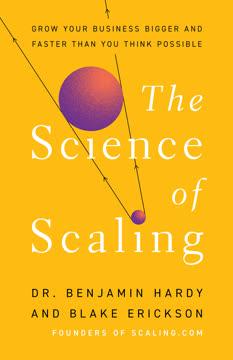
Every entrepreneur wants to scale. Few actually do. The gap between wanting growth and achieving it isn't a matter of effort. Most founders work relentlessly. They read the books, attend the conferences, hire the coaches, and implement the latest tactics. They optimize their funnels, refine their messaging, and expand their offerings. Yet the breakthrough remains elusive. Benjamin Hardy argues that the problem isn't what entrepreneurs are doing. It's what they're seeing. Or more precisely, what they're failing to see. The central premise of The Science of Scaling is deceptively simple: your goals determine your perception. The target you set doesn't just influence your motivation. It literally shapes what you notice, what you consider possible, and what paths you pursue. A small goal creates a narrow filter that hides the very opportunities that would enable exponential growth. A large goal, one that seems genuinely impossible, forces you to see differently. This isn't motivational rhetoric. Hardy draws on research from organizational psychology, strategy, and performance science to build his case. He points to Duke management researcher Dr. Sim Sitkin's work on stretch goals, which shows that objectives with unknown probability of attainment demand "radically new approaches" and "extreme redefinitions" of what an organization can become. He references McKinsey's study of 3,000 companies, which found that "supergrowers" achieving 60%+ annual growth at $100M revenue were eight times more likely to reach $1 billion. Slow growth, the data suggests, isn't safe. It compounds bad decisions. The problem with attainable goals is that they feel responsible. They seem prudent. A leader who sets a modest target looks grounded and realistic. But Hardy's counterintuitive claim is that attainable goals don't just underwhelm. They actively prevent scaling. Why? Because goals aren't merely endpoints. They're perceptual filters. Everything you see, decide, and build is shaped by the…
Continue reading in the MinuteRead app
Get the complete 30-minute summary of The Science of Scaling
Get the complete summary in the appYour goal is a perceptual filter. Set an impossible one.
Your floor matters more than your ceiling. Raise it ruthlessly.
Simplify until your company does exactly one thing brilliantly.
Stop lying to yourself about your performance, consequences, and trajectory.
Identify the crux and solve only that.
Hire Super Whos, not adequate performers.
"The Science of Scaling" is a strong fit if you want practical ideas around business, leadership, buisness, especially themes like your goal is a perceptual filter. set an impossible one; your floor matters more than your ceiling. raise it ruthlessly. The MinuteRead summary distills these concepts into a focused read, whether you're deciding whether to buy the book or applying its lessons at work.
Benjamin P. Hardy is an author and expert in organizational psychology, focusing on personal development and business growth. He has written multiple books, with "The Science of Scaling" being his latest work. Hardy's writing style is known for combining research-backed insights with practical strategies. He has a significant following in the entrepreneurial and self-improvement communities. Hardy also offers coaching services and has conducted workshops on rapid transformation. His approach oft…
View all summaries by Benjamin HardyContinue Reading
Access the complete 30-minute summary and thousands more nonfiction books in the MinuteRead app.

Continue reading the complete summary in the MinuteRead app.






