MinuteRead
30 min
Book summary
Premium summary · Opens in the app · 30 min read
In 1985, a young woman named Nadean Cool sought therapy for trauma related to a childhood event. During her treatment, her therapist used hypnosis and suggestive techniques to help her recover buried memories. Over time, Cool came to believe she had been abused in satanic rituals, had witnessed murders, and had developed over one hundred distinct personalities. She was eventually diagnosed with multiple personality disorder and spent years in treatment.
### How the Mind Forgets and Remembers
**Author:** Daniel L. Schacter **Estimated Reading Time:** 45 minutes
**What You'll Learn:** - Why forgetting is not always a failure but often a feature of a well-designed memory system - The seven distinct ways memory fails us, from everyday absent-mindedness to the persistence of traumatic memories - How memory distortions shape our identities, relationships, and legal systems - Practical strategies to strengthen memory where it matters most - Why the same mechanisms that cause memory errors also enable creativity, learning, and survival
**Who This Book Is For:** Anyone who has ever forgotten a name, misplaced keys, or wondered whether a cherished memory actually happened the way they remember it. This book is for people curious about how the mind works, professionals who rely on accurate recall, and anyone who wants to understand why memory, despite its flaws, remains one of the most remarkable achievements of the human brain.
In 1985, a young woman named Nadean Cool sought therapy for trauma related to a childhood event. During her treatment, her therapist used hypnosis and suggestive techniques to help her recover buried memories. Over time, Cool came to believe she had been abused in satanic rituals, had witnessed murders, and had developed over one hundred distinct personalities. She was eventually diagnosed with multiple personality disorder and spent years in treatment. None of it was true. Cool later sued her therapist and won a substantial settlement. The memories that had seemed so vivid, so emotionally real, had been inadvertently implanted through suggestion and expectation. Her case was not unique. Across the United States in the 1980s and 1990s, thousands of people recovered memories of abuse that never occurred, tearing families apart and raising profound questions about the reliability of human memory. At the same time, cognitive psychologists were documenting something equally unsettling in laboratory settings. People could be made to remember words they had never seen, events that had never happened, and details that had been subtly suggested to them. Memory, it turned out, was not a recording device that faithfully preserved the past. It was something far more complex, more fallible, and more interesting. Daniel Schacter, a professor of psychology at Harvard University, spent decades studying these phenomena. His research, along with that of colleagues around the world, revealed that memory errors follow predictable patterns. They are not random failures but systematic features of how the brain stores and retrieves information. Schacter grouped these patterns into seven categories, which he called the seven sins of memory. The sins have names that sound like they belong in a medieval morality play: transience, absent-mindedness, blocking, misattribution, suggestibility, bias, and persistence. The first three are sins of omission,…
Continue reading in the MinuteRead app
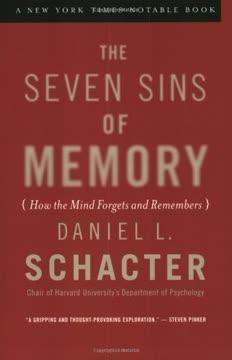
Get the complete 30-minute summary of The Seven Sins Of Memory Updated Edition
Get the complete summary in the appMemory is reconstructive, not reproductive. It rebuilds the past from fragments, not replays a recording.
The seven sins are transience, absent-mindedness, blocking, misattribution, suggestibility, bias, and persistence.
Each sin is a by-product of an adaptive process. The sins are trade-offs, not design flaws.
Transience is the fading of memories over time. Spaced repetition is the best defense.
Absent-mindedness is a failure of attention at encoding. You cannot remember what you do not notice.
Blocking is a retrieval failure. The information is there, but the pathway is blocked. Stop trying, and it will often su
"The Seven Sins Of Memory Updated Edition" is a strong fit if you want practical ideas around psychology, science, neuroscience, especially themes like memory is reconstructive, not reproductive. it rebuilds the past from fragments, not replays a recording; the seven sins are transience, absent-mindedness, blocking, misattribution, suggestibility, bias, and persistence. The MinuteRead summary distills these concepts into a focused read, whether you're deciding whether to buy the book or applying its lessons at work.
Daniel L. Schacter is a Harvard University Professor of Psychology renowned for his research on human memory and amnesia. His work focuses on conscious and nonconscious memory forms, brain mechanisms of memory distortion, and aging effects on memory. Schacter employs cognitive testing and brain imaging techniques in his studies. He has authored three books, edited seven volumes, and published over 200 scientific articles. His research covers topics such as Alzheimer's Disease, memory neuroscienc…
View all summaries by Daniel L. SchacterContinue Reading
Access the complete 30-minute summary and thousands more nonfiction books in the MinuteRead app.

Continue reading the complete summary in the MinuteRead app.