MinuteRead
30 min
Book summary
by Betsy Beyer
Premium summary · Opens in the app · 30 min read
Every organization that runs software in production eventually confronts the same uncomfortable truth: systems fail. They fail in predictable ways and in surprising ways. They fail because of bad code, bad configuration, bad assumptions, and sometimes just bad luck. The question is not whether failure will happen. The question is what you do before, during, and after it does.
**Author:** Betsy Beyer
**Estimated Reading Time:** 45 minutes
**What You'll Learn:**
- How to define and use Service Level Objectives to guide reliability decisions - Why measuring user experience matters more than watching system metrics - How to identify and eliminate operational toil through engineering - Why simplicity is a reliability strategy, not just an aesthetic preference - How to build incident response systems that actually learn from failure - How to safely roll out changes using canarying and progressive delivery - How to manage load, configuration, and system design for operational health - How to protect your team from operational overload and burnout
**Who This Book Is For:**
This book is for anyone responsible for running production systems: site reliability engineers, DevOps practitioners, engineering managers, and technical leaders who want to move beyond reactive firefighting and build organizations that can scale without breaking. If you have ever wondered how Google manages to run some of the largest systems in the world while still shipping features rapidly, this book explains the practical mechanics behind that capability.
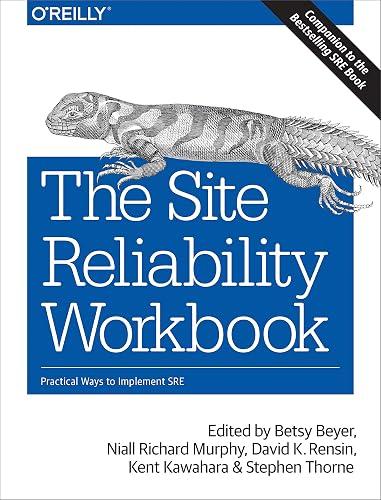
Every organization that runs software in production eventually confronts the same uncomfortable truth: systems fail. They fail in predictable ways and in surprising ways. They fail because of bad code, bad configuration, bad assumptions, and sometimes just bad luck. The question is not whether failure will happen. The question is what you do before, during, and after it does. Most organizations respond to failure by trying harder. They hire more people to watch dashboards. They add more alerts. They write longer runbooks. They demand more testing. They create more process. And yet, despite all this effort, the same incidents recur, the same teams burn out, and the same arguments about reliability versus features play out in meeting rooms week after week. The Site Reliability Workbook exists because there is a better way. It builds on the foundation laid by Google's original Site Reliability Engineering book, but it takes a fundamentally different approach. Where the first book explained the philosophy and principles of SRE, this book is about practice. It is a workbook in the truest sense: a collection of concrete methods, hard-won lessons, and practical guidance for implementing SRE in real organizations. The central insight of the book is that reliability is not a technical problem. It is an organizational problem. The tools exist. The monitoring systems exist. The automation frameworks exist. What most organizations lack is a coherent framework for making decisions about reliability: how much reliability do we need, how do we measure it, how do we know when to invest in it, and how do we balance it against the constant pressure to ship new features. This is where SLOs enter…
Continue reading in the MinuteRead app
Get the complete 30-minute summary of The Site Reliability Workbook
Get the complete summary in the appSLOs are targets for reliability, not guarantees of perfection. Use them to make data-driven decisions.
The error budget is your most powerful tool: it tells you when to ship and when to stabilize.
Measure what users experience, not what is easy to measure. Validate your metrics against user feedback.
Toil is the enemy. Identify it, measure it, and eliminate it by fixing root causes.
Simplicity is a reliability strategy. Fight complexity wherever it appears.
Incidents are inevitable. Prepare for them with clear roles and communication channels.
"The Site Reliability Workbook" is a strong fit if you want practical ideas around technology, programming, computer science, especially themes like slos are targets for reliability, not guarantees of perfection. use them to make data-driven decisions; the error budget is your most powerful tool: it tells you when to ship and when to stabilize. The MinuteRead summary distills these concepts into a focused read, whether you're deciding whether to buy the book or applying its lessons at work.
Motivated to help readers with once you’re equipped with a few guidelines, Betsy Beyer wrote “The Site Reliability Workbook” to package those ideas for a fast, focused read. In “The Site Reliability Workbook”, Betsy Beyer focuses on once you’re equipped with a few guidelines. Through “The Site Reliability Workbook”, Betsy Beyer distills the core ideas on technology into lessons readers can absorb in a single short sitting. Readers turn to this work when they want Betsy Beyer's perspective on the…
Continue Reading
Access the complete 30-minute summary and thousands more nonfiction books in the MinuteRead app.

Continue reading the complete summary in the MinuteRead app.