MinuteRead
30 min
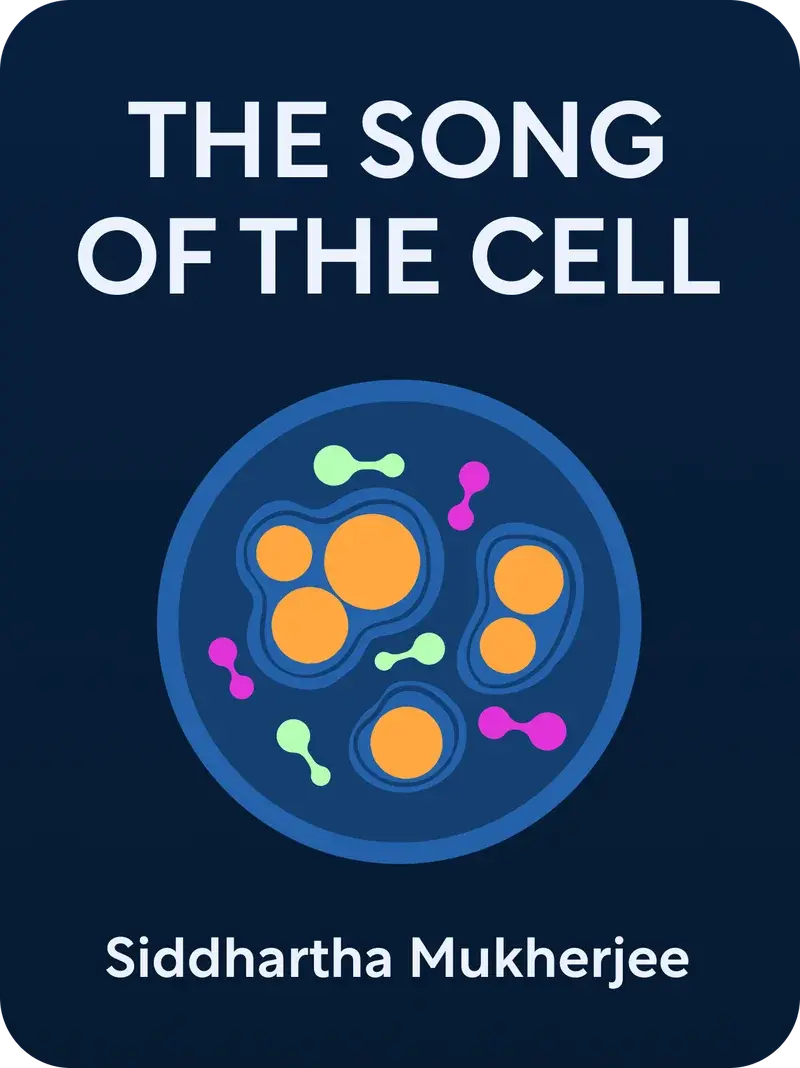
Book summary
Premium summary · Opens in the app · 30 min read
In 2017, Siddhartha Mukherjee stood in a laboratory watching a young woman receive an infusion of her own cells. Those cells had been extracted from her body, genetically reprogrammed in a laboratory, and multiplied into an army. Now they were flowing back into her bloodstream, hunting down the cancer that had resisted every other treatment. The woman had been given months to live. The cells changed everything.
**Author:** Siddhartha Mukherjee
**Estimated Reading Time:** 45 minutes
**What You'll Learn:** How the discovery of the cell transformed our understanding of life, health, and disease, and how cellular medicine is reshaping what it means to be human.
**Who This Book Is For:** Anyone curious about the fundamental unit of life, the history of scientific discovery, the biology of health and illness, and the future of medicine.
In 2017, Siddhartha Mukherjee stood in a laboratory watching a young woman receive an infusion of her own cells. Those cells had been extracted from her body, genetically reprogrammed in a laboratory, and multiplied into an army. Now they were flowing back into her bloodstream, hunting down the cancer that had resisted every other treatment. The woman had been given months to live. The cells changed everything. This moment, Mukherjee writes, was not an anomaly. It was the culmination of a revolution that began more than three centuries ago, when a Dutch cloth merchant pointed a handcrafted lens at a drop of pond water and discovered a world teeming with life too small to see. That discovery, and the centuries of investigation that followed, revealed something profound: every living thing, from the simplest bacterium to the most complex human being, is built from cells. These tiny units are not merely the building blocks of life. They are life itself. Mukherjee is uniquely positioned to tell this story. As a cancer physician and researcher, he has spent his career working at the intersection of cellular biology and human suffering. His previous book, The Emperor of All Maladies, traced the history of cancer and won the Pulitzer Prize. But The Song of the Cell is broader and more personal. It is an attempt to understand the cell not just as a scientific object, but as the key to understanding who we are, why we become ill, and how we might heal. The problem Mukherjee addresses is one of perspective. Most of us think of our bodies as solid, unified wholes. We speak of "my heart," "my skin," "my immune system" as though these were fixed and stable things. But the reality is more astonishing. Your body is a community of roughly thirty-seven trillion cells, each one a living entity with its own internal organization, its own metabolism, its own life cycle. These cells communicate, cooperate, compete, and sometimes betray one another. Your health is nothing more or less than the health of this cellular community. Your illnesses are disruptions in its harmony. This is not how medicine has traditionally thought about disease. For most of human history, illness was understood in terms of humors, miasmas, or imbalances of invisible forces. Even after the germ theory of…
Continue reading in the MinuteRead app
Get the complete 30-minute summary of The Song of the Cell
Get the complete summary in the appThe cell is the fundamental unit of life. All living organisms are composed of cells.
The cell theory states that all living things are composed of cells, that the cell is the basic unit of life, and that a
Cells are highly organized structures with specialized compartments called organelles.
Cells communicate through physical contact and chemical signals, coordinating the activities of the body.
The immune system is a cellular army that defends the body against pathogens.
Stem cells can self-renew and differentiate, making them essential for repair and regeneration.
"The Song of the Cell" is a strong fit if you want practical ideas around health & fitness, science, biology, especially themes like the cell is the fundamental unit of life. all living organisms are composed of cells; the cell theory states that all living things are composed of cells, that the cell is the basic unit of life, and that a. The MinuteRead summary distills these concepts into a focused read, whether you're deciding whether to buy the book or applying its lessons at work.
Siddhartha Mukherjee is a renowned cancer physician, researcher, and author. Born in India, he completed his education at prestigious institutions including Stanford, Oxford, and Harvard. Mukherjee is an assistant professor at Columbia University and a staff physician at Columbia University Medical Center. His writing has appeared in various publications, including Nature and The New York Times. Mukherjee's book "The Emperor of All Maladies: A Biography of Cancer" won the 2011 Pulitzer Prize for…
View all summaries by Siddhartha MukherjeeContinue Reading
Access the complete 30-minute summary and thousands more nonfiction books in the MinuteRead app.

Continue reading the complete summary in the MinuteRead app.