MinuteRead
30 min
Book summary
Premium summary · Opens in the app · 30 min read
Some people seem born to win. They stride through life accumulating victories, climbing ladders, and bending circumstances to their will. Others, equally talented and equally deserving, remain perpetually stuck, unable to break through despite genuine effort. The conventional explanation attributes this difference to innate qualities: some people simply have what it takes, while others do not.
**Author:** Ian H. Robertson
**Estimated Reading Time:** 45 minutes
**What You'll Learn:**
- Why winning changes your brain chemistry and makes future success more likely - How power transforms thinking, behavior, and relationships in ways both subtle and profound - Why Oscar winners live longer than equally successful nominees who never won - How to harness the biology of success without falling victim to power's corrupting influence - Practical strategies for building genuine empowerment in yourself and others
**Who This Book Is For:**
Anyone who has ever wondered why some people seem to ride an unstoppable wave of success while others remain stuck despite equal talent. Leaders who want to understand how power affects their judgment. Parents and educators who want to create environments that empower rather than diminish. And anyone curious about the hidden biological forces that shape human ambition, achievement, and the will to win.
Some people seem born to win. They stride through life accumulating victories, climbing ladders, and bending circumstances to their will. Others, equally talented and equally deserving, remain perpetually stuck, unable to break through despite genuine effort. The conventional explanation attributes this difference to innate qualities: some people simply have what it takes, while others do not. Ian Robertson, a professor of psychology at Trinity College Dublin and founding director of the Trinity College Institute of Neuroscience, spent decades investigating a different possibility. What if winning itself changes people? What if victory, even a small one, alters brain chemistry in ways that make future victories more likely? And what if losing does the opposite, creating a downward spiral that becomes increasingly difficult to escape? The implications of this question extend far beyond individual achievement. If winning changes the brain, then the distribution of success in society may not reflect the distribution of talent. Small initial advantages could compound into large disparities. Early opportunities could shape lifelong trajectories. And the gap between winners and losers might be maintained not by differences in ability, but by the biological consequences of winning and losing themselves. Robertson's investigation spans an extraordinary range of evidence. He examines the African cichlid fish, a creature that transforms from a dull, submissive animal into a vibrant, dominant one simply by gaining access to territory. He analyzes studies of Oscar winners, who live on average four years longer than equally successful nominees who never took home the statue. He explores the neuroscience of power, showing how gaining authority over others increases testosterone, boosts dopamine activity, and fundamentally rewires how the brain processes information. But this is not a simple celebration of winning. Robertson also documents the dark side of power: the hubris, the impaired judgment, the reduced empathy, the ethical failures that so…
Continue reading in the MinuteRead app
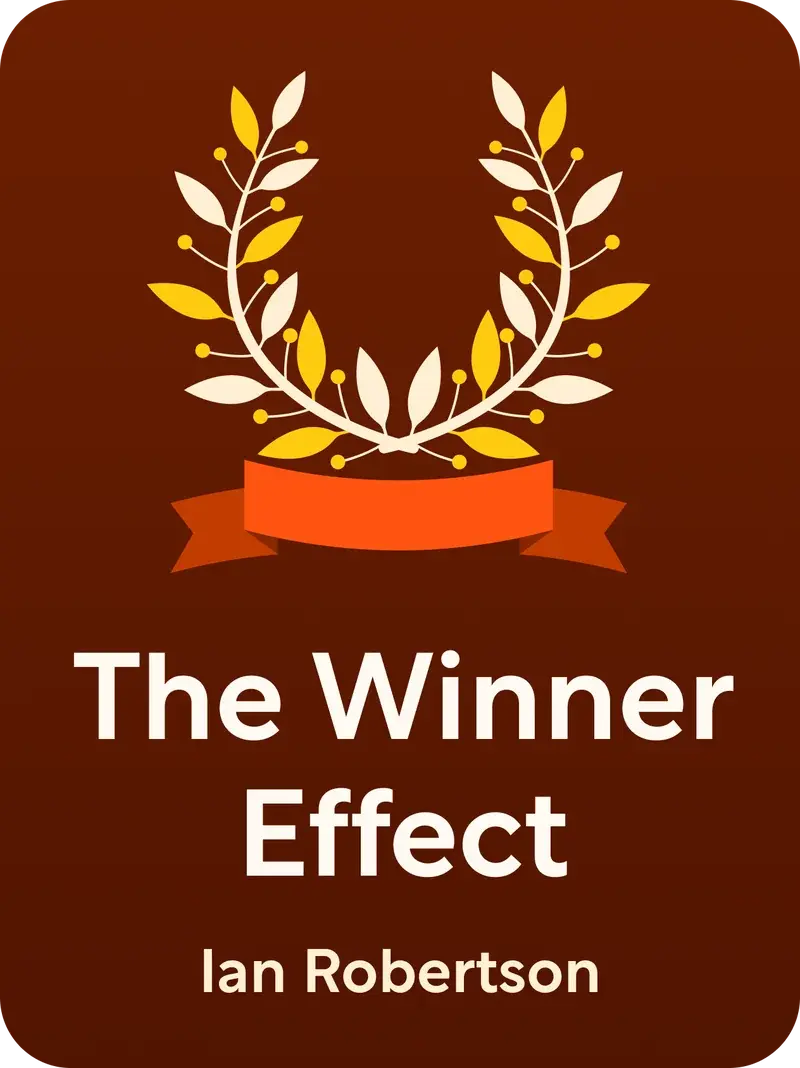
Get the complete 30-minute summary of The Winner Effect
Get the complete summary in the appWinning changes your brain chemistry, making future wins more likely.
Losing does the opposite, creating a biological basis for losing streaks.
Power increases focus and confidence but reduces empathy and judgment.
Oscar winners live four years longer than equally successful nominees.
Small wins matter. They trigger the winner effect and build momentum.
Power's effects are largely unconscious. You cannot see your own transformation.
"The Winner Effect" is a strong fit if you want practical ideas around psychology, self help, science, especially themes like winning changes your brain chemistry, making future wins more likely; losing does the opposite, creating a biological basis for losing streaks. The MinuteRead summary distills these concepts into a focused read, whether you're deciding whether to buy the book or applying its lessons at work.
Ian H. Robertson is a distinguished Professor of Psychology at Trinity College, Dublin, and founding Director of Trinity College Institute of Neuroscience. He holds visiting positions at several prestigious institutions and was previously a Senior Scientist at the University of Cambridge. Robertson has an extensive academic background, with degrees from Glasgow University and the University of London. He has published over 250 scientific articles in leading journals and authored numerous books, …
View all summaries by Ian H. RobertsonContinue Reading
Access the complete 30-minute summary and thousands more nonfiction books in the MinuteRead app.

Continue reading the complete summary in the MinuteRead app.