MinuteRead
30 min
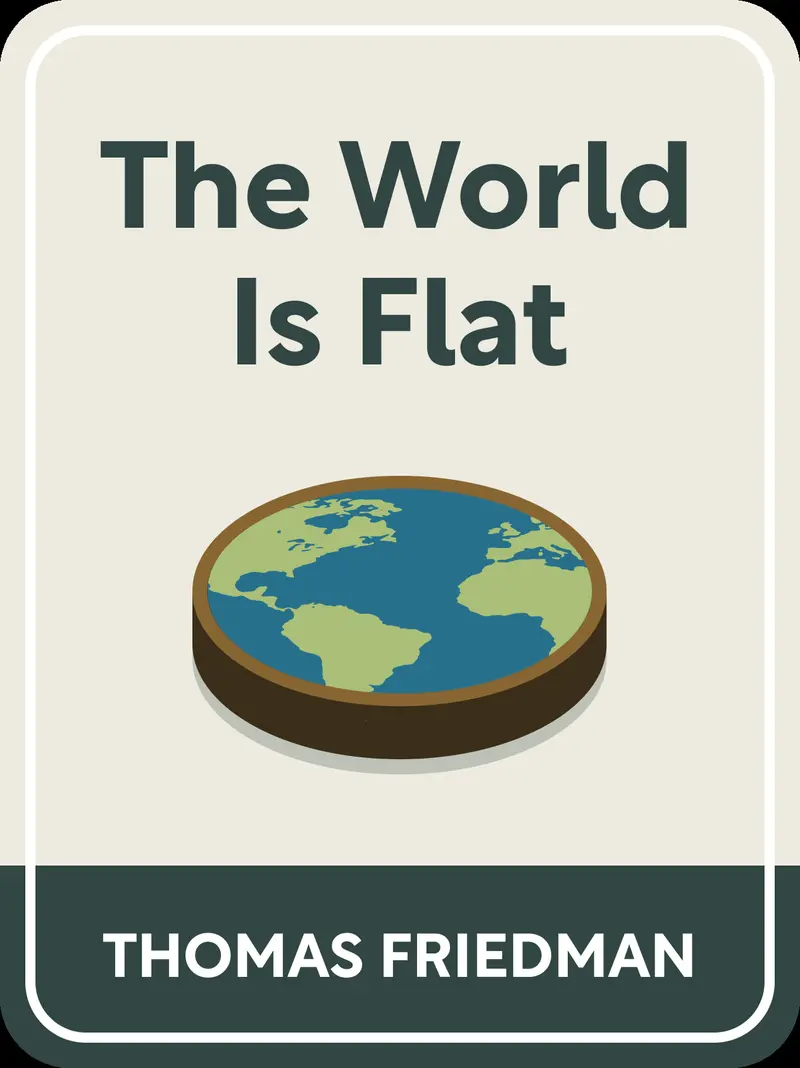
In the late 1990s, Thomas Friedman traveled to Bangalore, India, expecting to find a developing country struggling to catch up with the West. What he found instead unsettled and excited him. He walked into offices where Indian engineers were designing software for American companies, analyzing medical scans for American hospitals, and preparing tax returns for American accounting firms. The work was happening in real time, across oceans, as if distance had suddenly stopped mattering.
**Author:** Thomas L. Friedman **Estimated Reading Time:** 45 minutes
**What You'll Learn:** - Why the global competitive playing field is being leveled - The ten forces that flattened the world - How individuals, companies, and nations can adapt - Why America faces a quiet crisis in education and innovation - What skills matter most in a connected world
**Who This Book Is For:** Professionals navigating global competition, students preparing for careers in a connected economy, business leaders making strategic decisions, policymakers concerned with national competitiveness, and anyone curious about how technology is reshaping opportunity.
In the late 1990s, Thomas Friedman traveled to Bangalore, India, expecting to find a developing country struggling to catch up with the West. What he found instead unsettled and excited him. He walked into offices where Indian engineers were designing software for American companies, analyzing medical scans for American hospitals, and preparing tax returns for American accounting firms. The work was happening in real time, across oceans, as if distance had suddenly stopped mattering. He kept hearing the same phrase from executives and entrepreneurs: "The playing field is being leveled." At first, he thought it was just a metaphor. Then he began to see it everywhere. A small company in rural China could sell products to customers in Europe. A freelance designer in the Philippines could compete for contracts with agencies in New York. A teenager with a laptop and an internet connection could build a global audience. Friedman called this phenomenon "the flattening of the world." He did not mean that the world was becoming literally flat or that all differences between countries were disappearing. He meant something more specific and more consequential: the barriers that once protected people, companies, and nations from global competition were crumbling. For most of human history, geography was destiny. Where you were born largely determined your opportunities. If you were born in a wealthy country with strong institutions, you had access to education, capital, and markets. If you were born in a poor country, your options were limited no matter how talented you were. The cost of moving goods, information, and people across borders was high enough to create natural protection for local economies. That world no longer exists. The personal computer put powerful tools in the hands of ordinary people. Fiber-optic cable made it possible to transmit vast amounts of information across the planet almost instantly. Workflow software allowed people in different time zones to collaborate on the same project as if they were in the same room. Together, these technologies created something unprecedented: a global platform where individuals and small groups could compete with large organizations. This is not just a story about technology. It is a…
Continue reading in the MinuteRead app
Get the complete 30-minute summary of The World Is Flat
Get the complete summary in the appThe global competitive playing field is being leveled.
Globalization 3.0 is driven by individuals, not countries or companies.
Ten flatteners created the platform for global collaboration.
The Triple Convergence combined technology, practices, and people.
The Great Sorting Out is redefining identities and boundaries.
America faces a quiet crisis in education and innovation.
"The World Is Flat" is a strong fit if you want practical ideas around history, business, economics, especially themes like the global competitive playing field is being leveled; globalization 3.0 is driven by individuals, not countries or companies. The MinuteRead summary distills these concepts into a focused read, whether you're deciding whether to buy the book or applying its lessons at work.
Thomas L. Friedman is an acclaimed author, reporter, and columnist, known for his work on international affairs and globalization. Born in Minneapolis in 1953, he has won three Pulitzer Prizes and authored six bestselling books. Friedman became the New York Times Foreign Affairs columnist in 1995, aiming to broaden the definition of foreign affairs and make it accessible to general readers. He emphasizes the importance of on-the-ground reporting and seeks to understand the world through the tens…
View all summaries by Thomas L. FriedmanContinue Reading
Access the complete 30-minute summary and thousands more nonfiction books in the MinuteRead app.

Continue reading the complete summary in the MinuteRead app.