MinuteRead
30 min
Book summary
Premium summary · Opens in the app · 30 min read
Every day, you make thousands of decisions. Most of them happen without any conscious effort. You read a face in a fraction of a second. You sense hostility in a voice before you can articulate why. You drive a familiar route while your mind wanders elsewhere. You form an impression of a stranger within moments of meeting them.
**Author:** Daniel Kahneman
**Estimated Reading Time:** 45 minutes
**What You'll Learn:**
* Why your mind operates through two distinct systems, one fast and intuitive, the other slow and deliberate * How cognitive biases shape your judgments, decisions, and memories without your awareness * Why losses hurt more than gains feel good, and how this distorts your choices * How the remembering self dominates your experience of life, often to your detriment * Practical ways to recognize when your fast thinking is leading you astray
**Who This Book Is For:**
Anyone who makes decisions. That includes you, whether you are an executive weighing a strategic investment, a doctor evaluating a diagnosis, a parent deciding how to respond to a child, or simply someone trying to understand why you made a choice you later regretted. This book is for people who want to see the hidden machinery of their own minds.
Every day, you make thousands of decisions. Most of them happen without any conscious effort. You read a face in a fraction of a second. You sense hostility in a voice before you can articulate why. You drive a familiar route while your mind wanders elsewhere. You form an impression of a stranger within moments of meeting them. You trust these judgments. They feel right. They feel like you. But what if much of what you believe about your own thinking is wrong? Daniel Kahneman spent his career dismantling the comfortable assumption that humans are rational actors who weigh evidence carefully and choose wisely. He did not set out to prove that people are foolish. He set out to understand how the mind actually works, and what he found was both humbling and liberating. The mind, Kahneman discovered, operates through two distinct systems. One is fast, automatic, and effortless. It generates impressions, intuitions, and feelings. It is the voice that immediately says "something is wrong here" or "I like this person" or "that answer is obvious." The other system is slow, deliberate, and effortful. It can reason through complex problems, check the first system's output, and override impulses. But it is lazy, easily fatigued, and often content to endorse whatever the fast system serves up. This division of labor works remarkably well most of the time. The fast system evolved to keep us alive in a dangerous world where hesitation could be fatal. It recognizes patterns, detects threats, and makes split-second judgments that are often accurate. The problem is that it also makes systematic errors. It jumps to conclusions. It ignores base rates. It is swayed by irrelevant factors like the font in which a message is printed. It fears losses more than it values equivalent gains. And it constructs stories…
Continue reading in the MinuteRead app
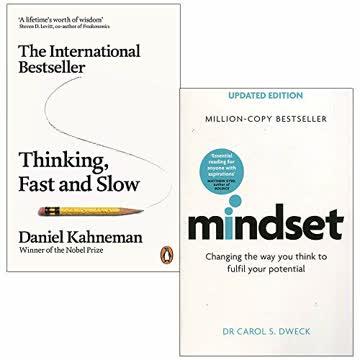
Get the complete 30-minute summary of Thinking, Fast and Slow By Daniel Kahneman & Mindset - Updated Edition
Get the complete summary in the appYour mind has two systems: System 1 is fast and automatic, System 2 is slow and deliberate.
System 2 is lazy and often endorses System 1's output without checking it.
Attention is a limited resource that can be depleted.
Familiarity is mistaken for truth, and repetition increases believability.
The mind seeks causal connections even when events are random.
Base rates are neglected when stereotypes are vivid.
"Thinking, Fast and Slow By Daniel Kahneman & Mindset - Updated Edition" is a strong fit if you want practical ideas around psychology, self help, business, especially themes like your mind has two systems: system 1 is fast and automatic, system 2 is slow and deliberate; system 2 is lazy and often endorses system 1's output without checking it. The MinuteRead summary distills these concepts into a focused read, whether you're deciding whether to buy the book or applying its lessons at work.
Carol S. Dweck, Ph.D. is a renowned psychologist and researcher in motivation. She holds the position of Lewis and Virginia Eaton Professor of Psychology at Stanford University and has previously taught at Columbia and Harvard. Dweck's research focuses on success and its cultivation. Her work has gained international recognition, with lectures delivered worldwide and election to the American Academy of Arts and Sciences. Her book "Self-Theories" received acclaim from the World Education Federati…
View all summaries by Carol S. DweckContinue Reading
Access the complete 30-minute summary and thousands more nonfiction books in the MinuteRead app.

Continue reading the complete summary in the MinuteRead app.