MinuteRead
30 min
Book summary
Premium summary · Opens in the app · 30 min read
There is a particular kind of suffering that comes from not knowing. It is not the sharp pain of a definitive loss, nor the clean ache of a decision made. It is the dull, grinding exhaustion of being suspended between two possibilities, unable to move toward either one. Millions of people live in this space for months, years, sometimes decades. They wake up each morning uncertain whether the person beside them is their future or their past.
**Author:** Mira Kirshenbaum
**Estimated Reading Time:** 45 minutes
**What You'll Learn:**
- How to recognize when you are trapped in relationship ambivalence and why it keeps you stuck - The specific diagnostic questions that reveal whether your relationship has a viable future - How to distinguish between normal relationship challenges and fatal flaws - Why love alone is never enough to sustain a partnership - How to trust your own judgment and make a decision you can live with
**Who This Book Is For:**
Anyone who has ever lain awake at night wondering whether to stay or go. Anyone who has felt paralyzed by conflicting emotions, torn between hope and exhaustion, unable to move forward in either direction. If you have ever said "I don't know whether to stay or leave" and meant it deeply, this book was written for you.
There is a particular kind of suffering that comes from not knowing. It is not the sharp pain of a definitive loss, nor the clean ache of a decision made. It is the dull, grinding exhaustion of being suspended between two possibilities, unable to move toward either one. Millions of people live in this space for months, years, sometimes decades. They wake up each morning uncertain whether the person beside them is their future or their past. Mira Kirshenbaum wrote this book because she recognized that relationship ambivalence is not a minor inconvenience. It is a psychological state that erodes self-trust, drains emotional energy, and prevents people from living fully in any area of their lives. The person who cannot decide whether to stay or leave is not just stuck in a relationship. They are stuck in their entire life. The problem is not that people lack information about their relationships. Most people in ambivalent relationships have spent enormous amounts of time analyzing their situation. They have talked to friends, read articles, consulted therapists, made lists of pros and cons. The problem is that they do not know which information matters. They are drowning in data without a framework for interpreting it. Kirshenbaum's approach is fundamentally different from most relationship advice. She does not tell people to follow their hearts. She does not tell them to stay and work harder. She does not tell them to leave and find something better. Instead, she offers something far more valuable: a method for determining, with reasonable confidence, whether a relationship is viable or not. The method is built on a simple premise. Some relationship problems are fixable. Others are not. Some sources of unhappiness can be addressed through effort, communication, therapy, and time. Others are structural, embedded in the fundamental nature of the relationship itself. The key to making a good…
Continue reading in the MinuteRead app
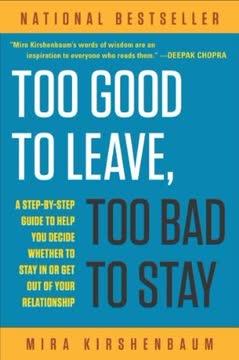
Get the complete 30-minute summary of Too Good to Leave, Too Bad to Stay
Get the complete summary in the appAmbivalence is a trap that becomes harder to escape over time. Set a deadline for your decision.
Love is not enough. You must also like your partner and share fundamental compatibility.
Disrespect is a fatal flaw. Contempt is the single best predictor of relationship failure.
Forbidden topics create walls. A relationship where important things cannot be discussed is not viable.
Power imbalances kill passion. A relationship that requires self-erasure is not worth keeping.
Core needs are not optional. If the relationship cannot meet them, the relationship is not viable.
"Too Good to Leave, Too Bad to Stay" is a strong fit if you want practical ideas around health & fitness, self help, relationships, especially themes like ambivalence is a trap that becomes harder to escape over time. set a deadline for your decision; love is not enough. you must also like your partner and share fundamental compatibility. The MinuteRead summary distills these concepts into a focused read, whether you're deciding whether to buy the book or applying its lessons at work.
Mira Kirshenbaum is a psychotherapist and relationship counselor based in Boston. She has extensive experience in helping couples navigate difficult relationship decisions. Kirshenbaum's approach focuses on providing practical, actionable advice rather than making decisions for her clients. Her writing style is described as easy to absorb and direct, while maintaining a neutral stance on relationship outcomes. Kirshenbaum's work draws from years of research and clinical experience, allowing her …
View all summaries by Mira KirshenbaumContinue Reading
Access the complete 30-minute summary and thousands more nonfiction books in the MinuteRead app.

Continue reading the complete summary in the MinuteRead app.