MinuteRead
30 min
Book summary
Premium summary · Opens in the app · 30 min read
Most traders spend their careers searching for the perfect indicator. They add moving averages, oscillators, and custom formulas to their charts, hoping that some combination of mathematical tools will unlock the market's secrets. They believe that if they can just find the right settings, the market will finally make sense.
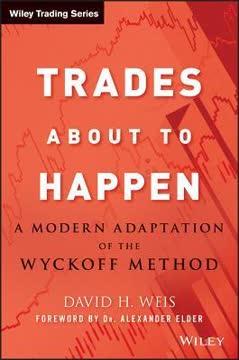
**Author:** David H. Weis **Estimated Reading Time:** 48 minutes
### What You'll Learn
The core principles of the Wyckoff method for reading markets through price and volume. You will learn to identify springs, upthrusts, and absorption phases. You will understand how to draw meaningful lines on charts and interpret what those lines reveal about market behavior. You will discover how to develop the trained judgment that separates professional traders from amateurs.
### Who This Book Is For
This book is for traders who want to move beyond memorizing patterns and toward understanding the forces that create those patterns. It is for anyone who has looked at a chart and wondered what the price action is actually revealing about the intentions of large market participants. It is for the trader who suspects that real edge comes not from indicators but from learning to read the story that price and volume tell together.
Most traders spend their careers searching for the perfect indicator. They add moving averages, oscillators, and custom formulas to their charts, hoping that some combination of mathematical tools will unlock the market's secrets. They believe that if they can just find the right settings, the market will finally make sense. David Weis offers a different path. He argues that the information traders need has been sitting in front of them all along, visible in the relationship between price movement and trading volume. The challenge is not finding more data. The challenge is learning to interpret the data that already exists. The foundation of this approach comes from Richard Wyckoff, a trader who began his career in the late nineteenth century and spent decades studying how markets actually work. Wyckoff started as a stock runner and worked his way up to running his own brokerage firm. Along the way, he developed a method for understanding markets that focused on the behavior of large operators, the professionals who move prices through their buying and selling activity. Wyckoff's central insight was simple but profound. Markets are not random. They are driven by the actions of large players who accumulate positions at low prices and distribute them at high prices. These operators leave footprints in the form of price and volume patterns. A trader who learns to read those footprints can align with the dominant forces rather than fighting against them. The problem is that most modern interpretations of Wyckoff's work have become rigid and mechanical. Traders memorize schematic diagrams of accumulation and distribution. They look for specific patterns and become frustrated when the market does not cooperate. They have lost touch with the original purpose of the method, which was to develop trained judgment rather than to follow rules. Weis seeks to…
Continue reading in the MinuteRead app
Get the complete 30-minute summary of Trades about to Happen
Get the complete summary in the appMarkets are driven by force, and that force is visible in the relationship between price and volume.
Each bar on a chart is a battle report. The range shows intensity, the close shows control, and volume shows effort.
Lines are drawn to be broken. Watch how price behaves around key levels to understand the story of the lines.
A spring is a failed breakdown below support. It reveals that sellers are weaker than they appeared and offers a high-pr
An upthrust is a failed breakout above resistance. It reveals that buyers are weaker than they appeared and offers a hig
Absorption is the process through which opposing pressure is overcome. It explains how trends persist and helps distingu
"Trades about to Happen" is a strong fit if you want practical ideas around finance, business, especially themes like markets are driven by force, and that force is visible in the relationship between price and volume; each bar on a chart is a battle report. the range shows intensity, the close shows control, and volume shows effort. The MinuteRead summary distills these concepts into a focused read, whether you're deciding whether to buy the book or applying its lessons at work.
David H. Weis is a professional trader and author specializing in technical analysis and the Wyckoff method of trading. He is known for his expertise in interpreting price action and volume in financial markets. Weis has developed his own techniques, including the Weis Wave, which builds upon Wyckoff principles. His work focuses on understanding market structure, support and resistance, and price behavior around key levels. Weis is respected in the trading community for his practical insights an…
View all summaries by David H. WeisContinue Reading
Access the complete 30-minute summary and thousands more nonfiction books in the MinuteRead app.

Continue reading the complete summary in the MinuteRead app.