MinuteRead
30 min
Book summary
Premium summary · Opens in the app · 30 min read
Anxiety feels like a personal failure. You know the experience: the racing heart, the tightening chest, the endless loop of worried thoughts that will not quiet down no matter how much you tell yourself to relax. You have probably tried to control it. Maybe you have practiced deep breathing, repeated positive affirmations, or simply tried to think your way out of worry. And yet, the anxiety returns. Sometimes it returns stronger than before.
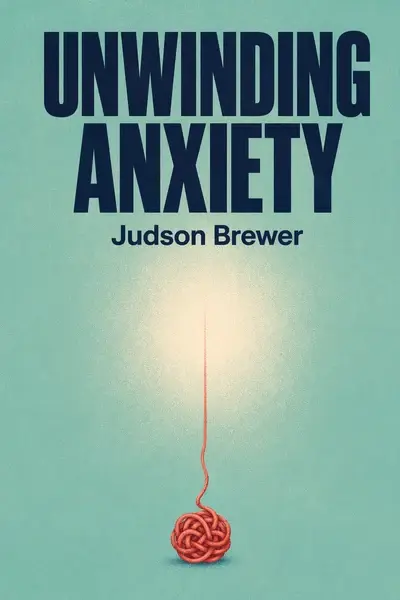
**Author:** Judson Brewer **Estimated Reading Time:** 42 minutes
**What You'll Learn:**
- Why anxiety is not a personal failing but a habit loop wired into your brain - How reward-based learning quietly drives worry, overthinking, and avoidance - Why willpower fails against anxiety and what actually works instead - How to map your own anxiety habit loops with precision - How to use curiosity and kindness as powerful internal rewards - A practical, neuroscience-backed path to lasting freedom from chronic anxiety
**Who This Book Is For:**
Anyone who has ever felt trapped in their own head. If you worry excessively, struggle with stress eating, doomscrolling, procrastination, or any behavior you know is unhelpful but cannot seem to stop, this book is for you. It is also for clinicians, coaches, and curious minds who want to understand the deeper mechanics of why we get stuck and how we can genuinely change.
Anxiety feels like a personal failure. You know the experience: the racing heart, the tightening chest, the endless loop of worried thoughts that will not quiet down no matter how much you tell yourself to relax. You have probably tried to control it. Maybe you have practiced deep breathing, repeated positive affirmations, or simply tried to think your way out of worry. And yet, the anxiety returns. Sometimes it returns stronger than before. Judson Brewer, a psychiatrist and neuroscientist, argues that this is not because you are weak or broken. It is because you have been attacking the problem from the wrong angle. Anxiety, he explains, is not primarily a thinking problem. It is a habit problem. And habits do not respond to logical arguments or sheer force of will. They respond to a specific kind of awareness, one that updates the brain's reward system and naturally dissolves the urge to worry. Brewer's work sits at the intersection of neuroscience and mindfulness. For decades, he has studied how habits form in the brain and how they can be changed. His research on smoking cessation, emotional eating, and anxiety has revealed a consistent pattern: when people learn to observe their own minds with curiosity rather than judgment, their unhealthy habits begin to lose their grip. The brain, it turns out, is remarkably plastic. It can learn new patterns at any age. But it needs the right conditions to do so. The problem with most anxiety treatments, Brewer suggests, is that they focus on managing symptoms rather than addressing the underlying mechanism. Cognitive approaches teach you to challenge irrational thoughts. Relaxation techniques help you calm your body in the moment. These tools have value, but they often fail to create lasting change because they do not address the habit loop that keeps…
Continue reading in the MinuteRead app
Get the complete 30-minute summary of Unwinding Anxiety
Get the complete summary in the appAnxiety is a habit loop, not a personal failing. It follows the same neurological rules as any other habit.
The habit loop consists of trigger, behavior, and reward. Map your loops to understand your anxiety.
Willpower fails because it does not change the reward value. Stop trying to force yourself to change.
Mindfulness is the foundation of habit change. Pay attention to the present moment with curiosity and without judgment.
The three gears are awareness, disenchantment, and the bigger, better offer. Practice them in sequence.
Disenchantment means paying close attention to what a behavior actually feels like. Notice that worrying is not actually
"Unwinding Anxiety" is a strong fit if you want practical ideas around health & fitness, self help, psychology, especially themes like anxiety is a habit loop, not a personal failing. it follows the same neurological rules as any other habit; the habit loop consists of trigger, behavior, and reward. map your loops to understand your anxiety. The MinuteRead summary distills these concepts into a focused read, whether you're deciding whether to buy the book or applying its lessons at work.
Judson Brewer is a psychiatrist, neuroscientist, and addiction expert. He is known for his research on mindfulness and habit change, particularly in relation to anxiety and addiction. Brewer has developed apps and programs to help people break bad habits and manage anxiety. He is the Director of Research and Innovation at the Mindfulness Center at Brown University. Brewer has given a popular TED Talk on breaking bad habits and has authored several books on mindfulness and behavior change. His wo…
View all summaries by Judson BrewerContinue Reading
Access the complete 30-minute summary and thousands more nonfiction books in the MinuteRead app.

Continue reading the complete summary in the MinuteRead app.