MinuteRead
30 min
Book summary
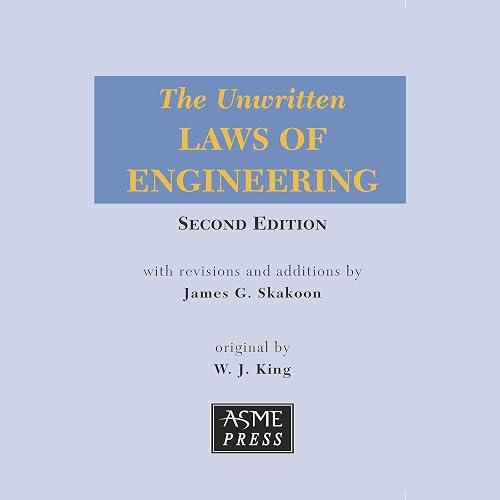
by W.J. King
Premium summary · Opens in the app · 30 min read
Every engineering education teaches the laws of thermodynamics, the principles of structural analysis, and the mathematics of circuit design. These are the written laws of the profession. They are codified in textbooks, tested in examinations, and reinforced through years of practice. Master them, and you can design a bridge, build a machine, or solve a complex technical problem.
**Author:** W.J. King
**Estimated Reading Time:** 45 minutes
**What You'll Learn**
The professional principles that determine whether an engineer succeeds or stalls. This book reveals the unwritten rules governing workplace conduct, communication, responsibility, leadership, and career growth that no engineering curriculum teaches but every successful engineer eventually learns.
**Who This Book Is For**
Engineers at any career stage who want to understand why technical competence alone rarely leads to professional success. It is equally valuable for managers who supervise technical professionals and for anyone working in an organization where technical work meets human dynamics.
Every engineering education teaches the laws of thermodynamics, the principles of structural analysis, and the mathematics of circuit design. These are the written laws of the profession. They are codified in textbooks, tested in examinations, and reinforced through years of practice. Master them, and you can design a bridge, build a machine, or solve a complex technical problem. But spend a few years working in any engineering organization, and you will discover something unsettling. The engineers who advance are not necessarily the ones who earned the highest grades. The engineers who command respect are not always the ones with the deepest technical knowledge. The engineers who lead successful projects are not simply the best analysts or designers. Something else is at work. Something that is never written down in any employee handbook, never taught in any lecture hall, and never appears on any certification exam. Yet these unwritten laws govern careers with the same certainty as the laws of physics govern the behavior of materials. W.J. King first articulated these unwritten laws in 1944, drawing on his observations of what actually made engineers effective in real organizations. His central insight was deceptively simple: personal and administrative problems cause more professional failures than technical errors ever do. An engineer who makes a calculation mistake can usually catch it, correct it, and learn from it. But an engineer who alienates colleagues, fails to communicate clearly, or misunderstands the nature of professional responsibility may never recover. The book's endurance across more than eight decades speaks to the timelessness of its wisdom. Technology has changed beyond recognition since King first wrote. The slide rule gave way to the calculator, which gave way to the computer, which gave way to the smartphone. But the fundamental challenges of working effectively with other human beings in a professional setting have remained remarkably constant. Consider what actually happens in a typical engineering workplace. A young engineer receives an assignment that seems beneath their abilities. How they respond to that assignment will shape how their superiors view them for years to come. A project manager must explain a technical decision to a non-technical executive. The…
Continue reading in the MinuteRead app
Get the complete 30-minute summary of Unwritten Laws of Engineering
Get the complete summary in the appGive your best effort to every assignment, no matter how small or trivial it seems.
Communicate with conciseness and clarity, putting the most important information first.
Understand that your professional responsibility is broader than you think and cannot be delegated.
Delegate effectively to develop your team and free yourself for higher-value work.
Take ownership of your own professional development and maintain your employability.
Let ethical behavior govern your actions, even when it is difficult or costly.
"Unwritten Laws of Engineering" is a strong fit if you want practical ideas around engineering, business, leadership, especially themes like give your best effort to every assignment, no matter how small or trivial it seems; communicate with conciseness and clarity, putting the most important information first. The MinuteRead summary distills these concepts into a focused read, whether you're deciding whether to buy the book or applying its lessons at work.
Motivated to help readers with however menial and trivial your early assignments may appear, W.J. King wrote “Unwritten Laws of Engineering” to package those ideas for a fast, focused read. In “Unwritten Laws of Engineering”, W.J. King focuses on however menial and trivial your early assignments may appear. Through “Unwritten Laws of Engineering”, W.J. King distills the core ideas on engineering into lessons readers can absorb in a single short sitting. Readers turn to this work when they want W…
Continue Reading
Access the complete 30-minute summary and thousands more nonfiction books in the MinuteRead app.

Continue reading the complete summary in the MinuteRead app.