MinuteRead
30 min
Book summary
by Georgi Tsvetanov
Premium summary · Opens in the app · 30 min read
Most people go through life without ever learning how to read a financial statement. They work for companies, buy products from companies, invest in companies, and sometimes start companies of their own. Yet when someone puts a balance sheet or an income statement in front of them, their eyes glaze over. The numbers blur together. The terminology feels like a foreign language.
**Author:** Georgi Tsvetanov
**Estimated Reading Time:** 45 minutes
**What You'll Learn:**
- How to read and interpret the three essential financial statements - Why cash and profit are not the same thing, and why the difference matters - How to use financial ratios to evaluate any company's health - What makes a business valuable and how to spot warning signs - How every department in a company influences financial results
**Who This Book Is For:**
This book is for anyone who has ever felt lost in a conversation about business finance. It is for the entrepreneur who wants to understand what their accountant is telling them. It is for the manager who wants to contribute to strategic discussions. It is for the investor who wants to make better decisions. And it is for the curious person who simply wants to understand how businesses work from the inside out.
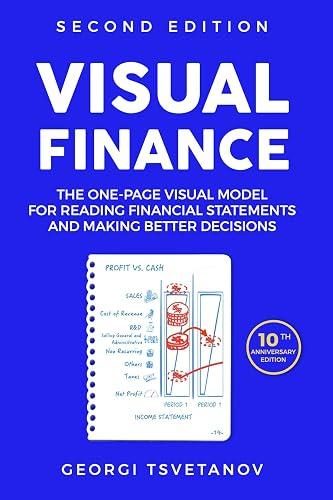
Most people go through life without ever learning how to read a financial statement. They work for companies, buy products from companies, invest in companies, and sometimes start companies of their own. Yet when someone puts a balance sheet or an income statement in front of them, their eyes glaze over. The numbers blur together. The terminology feels like a foreign language. This is not a personal failing. It is a systemic one. Schools teach algebra, geometry, and calculus, but rarely teach students how to understand a profit and loss statement. Universities produce graduates who can analyze Shakespeare and solve differential equations, but who cannot explain the difference between revenue and profit. The financial world, meanwhile, operates on a set of concepts and tools that are not inherently difficult. They are simply unfamiliar. Georgi Tsvetanov wrote Visual Finance to close this gap. His central insight is simple: financial concepts become clear when they are presented visually and explained in plain language. The book strips away the jargon and the intimidation factor, revealing the underlying logic of business finance. The problem is not that finance is too complex for ordinary people to understand. The problem is that finance has traditionally been taught in a way that makes it seem more complex than it actually is. Accountants and financial professionals have their own vocabulary, their own conventions, and their own ways of presenting information. This creates an artificial barrier between those who understand the language and those who do not. That barrier has real consequences. On a personal level, financial illiteracy leads to poor decisions about saving, spending, and investing. People who do not understand compound interest, debt management, or basic budgeting are at a significant disadvantage in life. They are more vulnerable to predatory lending, more likely to accumulate unmanageable debt, and less…
Continue reading in the MinuteRead app
Get the complete 30-minute summary of Visual Finance
Get the complete summary in the appThe balance sheet shows what a company owns and how it paid for those things. Assets always equal liabilities plus equit
The income statement shows whether a company made money during a period. Revenue minus expenses equals net income.
The cash flow statement shows how money actually moved. Cash and profit are not the same thing.
Operating cash flow is the most important indicator of financial health. Strong operating cash flow means the core busin
Ratios provide context. A number is only meaningful when compared to history, industry averages, or competitors.
Return on assets equals margin times turnover. Improve either one to improve returns.
"Visual Finance" is a strong fit if you want practical ideas around finance, business, economics, especially themes like the balance sheet shows what a company owns and how it paid for those things. assets always equal liabilities plus equit; the income statement shows whether a company made money during a period. revenue minus expenses equals net income. The MinuteRead summary distills these concepts into a focused read, whether you're deciding whether to buy the book or applying its lessons at work.
Motivated to help readers with "Economic knowledge is essential both on a personal and professional level." Personal finance management, Georgi Tsvetanov wrote “Visual Finance” to package those ideas for a fast, focused read. In “Visual Finance”, Georgi Tsvetanov focuses on "Economic knowledge is essential both on a personal and professional level." Personal finance management. Through “Visual Finance”, Georgi Tsvetanov distills the core ideas on finance into lessons readers can absorb in a sing…
Continue Reading
Access the complete 30-minute summary and thousands more nonfiction books in the MinuteRead app.

Continue reading the complete summary in the MinuteRead app.