MinuteRead
30 min
Book summary
Premium summary · Opens in the app · 30 min read
The moment you become a manager, everything changes. One day you are responsible for your own work, your own deadlines, your own performance. The next day you are responsible for the work, deadlines, and performance of other people. Nobody hands you a manual. Nobody tells you how to handle the employee who is brilliant but toxic, the team member who misses every deadline, or the colleague who now reports to you and resents it. You are expected to figure it out as you go, and the stakes are high.
### The Essential Guide for New Managers and Leaders
**Author:** Peter Economy
**Estimated Reading Time:** 45 minutes
**What You'll Learn:**
- How to shift from doing the work to leading the people who do the work - Why delegation is the single most important skill for new managers - How to build a culture where people learn, grow, and perform at their best - What truly motivates employees beyond money and titles - How to handle the hardest parts of management: discipline, termination, and crisis - How to recruit, retain, and develop top talent - How to navigate office politics without losing your integrity
**Who This Book Is For:**
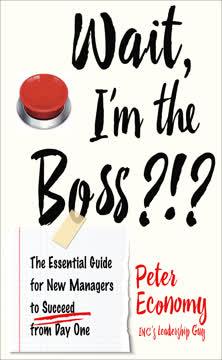
This book is for anyone who has recently stepped into a management role and suddenly realized that being good at your job does not automatically make you good at leading others. It is for the first-time supervisor, the newly promoted team lead, the entrepreneur who now has employees, and the experienced professional who never received formal management training. If you have ever thought, "Wait, I'm the boss?!?" this book is for you.
The moment you become a manager, everything changes. One day you are responsible for your own work, your own deadlines, your own performance. The next day you are responsible for the work, deadlines, and performance of other people. Nobody hands you a manual. Nobody tells you how to handle the employee who is brilliant but toxic, the team member who misses every deadline, or the colleague who now reports to you and resents it. You are expected to figure it out as you go, and the stakes are high. Peter Economy wrote this book because he saw a pattern. Talented people get promoted into management roles because they excelled at their jobs. Then they struggle. Not because they lack intelligence or work ethic, but because the skills that made them successful as individual contributors are not the skills that make people successful as managers. The engineer who writes flawless code must now learn how to give feedback. The salesperson who closes every deal must now learn how to coach others to close deals. The accountant who never misses a detail must now learn how to see the big picture. The problem is that most organizations do a poor job of preparing people for this transition. They promote first and train later, if they train at all. The result is predictable: frustrated managers, disengaged employees, and teams that underperform. Gallup research has consistently shown that the single biggest factor in employee engagement is the quality of the direct manager. When managers are unprepared, everyone suffers. This book addresses that gap. It is a practical guide to the fundamentals of management,…
Continue reading in the MinuteRead app
Get the complete 30-minute summary of Wait, I'm the Boss?!?
Get the complete summary in the app**Management is about getting work done through other people.** Shift from doing to enabling.
**Delegate effectively.** Decide what not to do is as important as deciding what to do.
**Communicate a clear mission.** Everything begins with mission, everything flows from mission.
**Tap into intrinsic motivators.** Autonomy, mastery, purpose, and recognition matter more than money.
**Create safe-to-fail experiments.** Small, low-risk tests with quick feedback loops drive learning and innovation.
**Build a diverse and inclusive team.** Diversity without inclusion is not enough.
"Wait, I'm the Boss?!?" is a strong fit if you want practical ideas around management, leadership, reference, especially themes like **management is about getting work done through other people.** shift from doing to enabling; **delegate effectively.** decide what not to do is as important as deciding what to do. The MinuteRead summary distills these concepts into a focused read, whether you're deciding whether to buy the book or applying its lessons at work.
Peter Economy is a prolific author and business expert known for his practical management advice. He has written numerous books on leadership, entrepreneurship, and workplace success. Economy's writing style is often described as accessible and easy to understand, making complex business concepts approachable for readers at various levels of experience. His work frequently focuses on helping new managers and leaders develop their skills and navigate the challenges of the modern workplace. Econom…
View all summaries by Peter EconomyContinue Reading
Access the complete 30-minute summary and thousands more nonfiction books in the MinuteRead app.

Continue reading the complete summary in the MinuteRead app.