MinuteRead
30 min
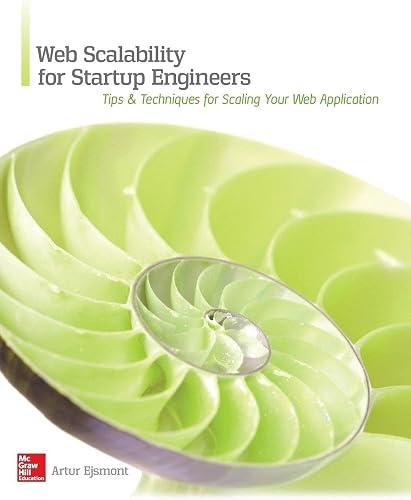
Book summary
by Artur Ejsmont
Premium summary · Opens in the app · 30 min read
Every startup dreams of the hockey stick growth curve. The product launches, users trickle in, and then something happens. A blog post goes viral. A prominent influencer mentions the product. A major customer signs on. Suddenly, traffic doubles, then triples, then grows by an order of magnitude. The servers start to strain. Response times creep upward. The database locks up. The site goes down.
**Author:** Artur Ejsmont
**Estimated Reading Time:** 45 minutes
**What You'll Learn:**
- Why most scalability failures are actually design failures - How to build systems that scale without over-engineering - The core principles that separate scalable architectures from brittle ones - Practical strategies for scaling every layer of your application stack - How to apply these ideas immediately, even in a small startup
**Who This Book Is For:**
This book is for engineers who are building web applications that need to grow. You might be the first technical hire at a startup, a full-stack developer suddenly responsible for architecture decisions, or an experienced engineer who wants to sharpen your system design instincts. You do not need to be a distributed systems expert. You need to understand the principles that make systems scalable, and you need to know how to apply them in the real world, where time is short and trade-offs are constant.
Every startup dreams of the hockey stick growth curve. The product launches, users trickle in, and then something happens. A blog post goes viral. A prominent influencer mentions the product. A major customer signs on. Suddenly, traffic doubles, then triples, then grows by an order of magnitude. The servers start to strain. Response times creep upward. The database locks up. The site goes down. This is the moment every engineer fears and every startup hopes for. And this is the moment when scalability stops being an abstract concern and becomes an existential one. The problem is that most engineers do not learn how to build scalable systems until they have already built systems that do not scale. University courses focus on algorithms and data structures. Bootcamps teach frameworks and deployment. But the art of designing systems that can grow from a thousand users to a million users is rarely taught in a structured way. Engineers are expected to pick it up through painful experience, usually at three in the morning when the site is down and the CEO is calling. Artur Ejsmont wrote this book to fill that gap. His central argument is both simple and profound: most scalability problems are not infrastructure problems. They are design problems. The systems that fail under load usually fail because of decisions made months or years earlier, when the code was first written. A tightly coupled architecture, a poorly chosen data model, a missing caching layer, a synchronous process that should have been asynchronous. These are not problems you can solve by buying more servers. They are problems you solve by writing better software. The good news is that the principles of scalable design are not mysterious. They are learnable. They can be applied by any engineer, regardless of experience…
Continue reading in the MinuteRead app
Get the complete 30-minute summary of Web Scalability for Startup Engineers
Get the complete summary in the appScalability is a design problem. Poorly designed systems do not scale, no matter how much infrastructure you throw at th
Keep it simple. Simple systems are easier to understand, modify, and scale.
Loosen your coupling. Minimize dependencies between components so they can evolve and scale independently.
Make servers stateless. Store state externally so any server can handle any request.
Cache aggressively but selectively. Store frequently accessed data close to the user to reduce load on slower sources.
Go asynchronous when possible. Defer work that does not need to happen immediately.
"Web Scalability for Startup Engineers" is a strong fit if you want practical ideas around programming, computer science, technology, especially themes like scalability is a design problem. poorly designed systems do not scale, no matter how much infrastructure you throw at th; keep it simple. simple systems are easier to understand, modify, and scale. The MinuteRead summary distills these concepts into a focused read, whether you're deciding whether to buy the book or applying its lessons at work.
Motivated to help readers with many of the scalability issues encountered in real-world projects can be boiled down to violations of core, Artur Ejsmont wrote “Web Scalability for Startup Engineers” to package those ideas for a fast, focused read. In “Web Scalability for Startup Engineers”, Artur Ejsmont focuses on many of the scalability issues encountered in real-world projects can be boiled down to violations of core. Through “Web Scalability for Startup Engineers”, Artur Ejsmont distills the…
Continue Reading
Access the complete 30-minute summary and thousands more nonfiction books in the MinuteRead app.

Continue reading the complete summary in the MinuteRead app.