MinuteRead
30 min
Book summary
by King Yao
Premium summary · Opens in the app · 30 min read
Most people approach sports betting the way they approach a lottery ticket. They pick a team they like, place a wager, and hope for the best. The outcome feels like a matter of luck, and over time, the losses accumulate. The sportsbook always seems to win, and the bettor always seems to lose. This pattern is so common that most people accept it as inevitable. They treat betting as entertainment, an expense, or a vice. They never stop to ask whether there is a better way.
**Author:** King Yao
**Estimated Reading Time:** 45 minutes
**What You'll Learn:**
- How to think about sports betting as an analytical discipline rather than gambling - The mathematical foundations of expected value and why they determine long-term success - How sportsbooks set lines and where inefficiencies create opportunity - Specific strategies for handicapping, relative-value betting, and market exploitation - How to manage risk, hedge intelligently, and build a sustainable betting practice
**Who This Book Is For:**
This book is for anyone who wants to move beyond casual sports betting and develop a serious, disciplined approach to finding value in sports markets. Whether you are a complete beginner or an experienced bettor looking to sharpen your analytical framework, the principles here apply across sports and bet types. If you have ever suspected that successful betting requires more than picking winners, this book will show you exactly what that means.
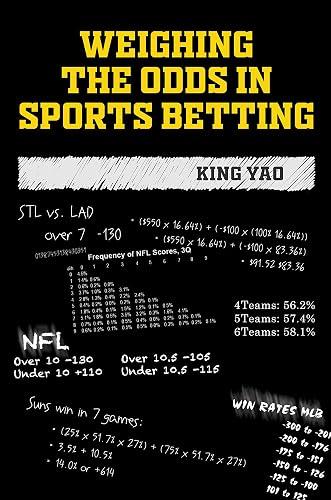
Most people approach sports betting the way they approach a lottery ticket. They pick a team they like, place a wager, and hope for the best. The outcome feels like a matter of luck, and over time, the losses accumulate. The sportsbook always seems to win, and the bettor always seems to lose. This pattern is so common that most people accept it as inevitable. They treat betting as entertainment, an expense, or a vice. They never stop to ask whether there is a better way. King Yao wrote *Weighing the Odds in Sports Betting* to answer that question. His answer is clear: there is a better way, but it requires a fundamental shift in how you think about sports betting. The shift is from gambling to analysis, from hope to calculation, from opinion to evidence. Yao draws on principles from finance, probability, and market theory to show that sports betting can be approached as a serious analytical discipline. The same tools that help investors evaluate stocks can help bettors evaluate point spreads. The same discipline that protects a trading account can protect a betting bankroll. The problem is not that sports betting is inherently unbeatable. The problem is that most people never learn how to evaluate a wager properly. They do not understand expected value. They do not know how sportsbooks set lines. They do not recognize the difference between a bet that feels good and a bet that has positive mathematical expectation. They bet with their hearts instead of their heads, and the sportsbook profits from that predictable behavior. Yao's approach is different because it treats sports betting as a market. Sportsbooks are market makers. Sharp bettors are sophisticated traders. Square bettors are uninformed participants who provide the money that everyone else competes for. Once you understand this structure, you…
Continue reading in the MinuteRead app
Get the complete 30-minute summary of Weighing the Odds in Sports Betting
Get the complete summary in the appFind value, not winners. Your probability estimate must exceed the implied probability of the odds.
Calculate expected value for every bet. Positive EV bets are profitable in the long run.
Understand that the vig makes most bets negative EV. You need to win at least 52.4% at -110 to break even.
Sportsbooks are market makers, not predictors. Lines reflect market forces, not necessarily true probabilities.
Inefficiencies exist where square money distorts lines, knowledge gaps persist, or stale lines linger.
Hedge only when the risk is too great or the hedge itself has positive EV. Automatic hedging costs money.
"Weighing the Odds in Sports Betting" is a strong fit if you want practical ideas around sports, business, finance, especially themes like find value, not winners. your probability estimate must exceed the implied probability of the odds; calculate expected value for every bet. positive ev bets are profitable in the long run. The MinuteRead summary distills these concepts into a focused read, whether you're deciding whether to buy the book or applying its lessons at work.
Motivated to help readers with the purpose of this book is to give you tools to succeed at sports betting, King Yao wrote “Weighing the Odds in Sports Betting” to package those ideas for a fast, focused read. In “Weighing the Odds in Sports Betting”, King Yao focuses on the purpose of this book is to give you tools to succeed at sports betting. Through “Weighing the Odds in Sports Betting”, King Yao distills the core ideas on sports into lessons readers can absorb in a single short sitting. Read…
Continue Reading
Access the complete 30-minute summary and thousands more nonfiction books in the MinuteRead app.

Continue reading the complete summary in the MinuteRead app.