MinuteRead
30 min
Book summary
Premium summary · Opens in the app · 30 min read
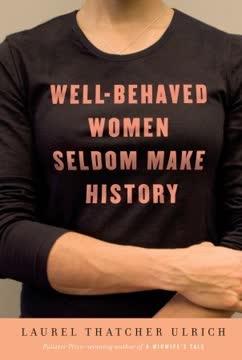
In 1976, Laurel Thatcher Ulrich published a scholarly article about Puritan funeral sermons. Buried in that academic text was a single sentence that would eventually take on a life of its own: "Well-behaved women seldom make history."
**Author:** Laurel Thatcher Ulrich
**Estimated Reading Time:** 45 minutes
**What You'll Learn:** Why the stories of ordinary women matter as much as those of queens and rebels, how women across centuries have shaped history through both defiance and quiet persistence, and what it truly means to "make history" when the historical record has so often ignored half of humanity.
**Who This Book Is For:** Readers curious about the hidden lives of women, anyone who has wondered why history books feel incomplete, and those who want to understand how the past shapes our present understanding of gender, power, and memory.
In 1976, Laurel Thatcher Ulrich published a scholarly article about Puritan funeral sermons. Buried in that academic text was a single sentence that would eventually take on a life of its own: "Well-behaved women seldom make history." Ulrich did not intend it as a rallying cry. She was making a dry observation about the nature of historical records. Women who followed the rules, who lived quiet lives of domestic labor and community service, rarely appeared in the documents historians relied upon. Their names did not appear in political chronicles. Their achievements were not celebrated in public monuments. They simply lived, worked, loved, and died, leaving behind little trace. But the sentence escaped the confines of academic publishing. It appeared on bumper stickers and T-shirts. It became a slogan for women who wanted to break free from expectations. It was quoted in graduation speeches and feminist manifestos. And somewhere along the way, its meaning shifted. The sentence came to be understood as an endorsement of misbehavior, a celebration of women who refused to follow the rules. When Ulrich finally sat down to write this book, she had a more nuanced story to tell. The original sentence was not a call to rebellion. It was an observation about the nature of historical memory. History, as traditionally written, has favored the spectacular, the public, the disruptive. It has recorded wars and elections, revolutions and discoveries. It has paid far less attention to the daily work of sustaining life, raising children, tending the sick, and building communities. And because women have historically been assigned to those quieter realms, their contributions have been systematically erased from the record. But Ulrich's deeper point is more provocative. Well-behaved women do make history. They make history when they keep diaries that later generations read. They make history when they preserve family stories and community traditions. They make history when they do the unexpected, even within the constraints of their expected roles. And they make history when later generations care enough to look for them. This book is an exploration of that paradox. It moves across centuries and continents, from…
Continue reading in the MinuteRead app
Get the complete 30-minute summary of Well-Behaved Women Seldom Make History
Get the complete summary in the appThe absence of women from history reflects a failure of historical imagination, not a lack of female achievement.
Well-behaved women make history when they create and preserve records, and when later generations care enough to read th
Women have always found ways to exercise agency, even within the most oppressive systems.
The Amazon myth reveals deep cultural anxieties about female power, but it also offers a vision of female strength and a
Women were writing and publishing in Shakespeare's England, despite overwhelming obstacles.
The narratives of enslaved women expose the hypocrisy of ideals of womanhood that applied only to white women.
"Well-Behaved Women Seldom Make History" is a strong fit if you want practical ideas around history, feminism, womens, especially themes like the absence of women from history reflects a failure of historical imagination, not a lack of female achievement; well-behaved women make history when they create and preserve records, and when later generations care enough to read th. The MinuteRead summary distills these concepts into a focused read, whether you're deciding whether to buy the book or applying its lessons at work.
Laurel Thatcher Ulrich is a renowned historian and Harvard University professor specializing in early American social history, women's history, and material culture. She has authored several acclaimed books, including "Good Wives" and "A Midwife's Tale," the latter winning the Pulitzer Prize for History in 1991. Ulrich's work often incorporates museum-based research alongside traditional archival sources. Her most recent book, "Well-behaved Women Seldom Make History," explores the impact of wome…
View all summaries by Laurel Thatcher UlrichContinue Reading
Access the complete 30-minute summary and thousands more nonfiction books in the MinuteRead app.

Continue reading the complete summary in the MinuteRead app.