MinuteRead
30 min
Book summary
Premium summary · Opens in the app · 30 min read
Buddhism has been misunderstood perhaps more than any other major religious tradition. In the West, it has been characterized as pessimistic, nihilistic, and life-denying. It has been dismissed as a philosophy of escape, a religion of negation, a path that turns its back on the world. These misunderstandings are not merely academic problems. They prevent people from encountering one of the most practical, clear-eyed, and liberating systems of thought ever developed.
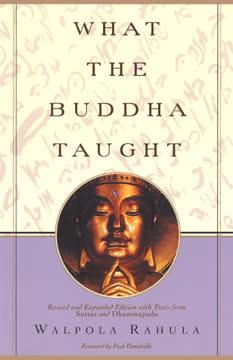
**Author:** Walpola Rahula **Estimated Reading Time:** 55 minutes
**What You'll Learn:**
The foundational teachings of Buddhism as presented by one of the twentieth century's most respected Buddhist scholars. You will learn the Four Noble Truths, the Noble Eightfold Path, the doctrine of no-self, the nature of karma and rebirth, the practice of mindfulness, and the meaning of Nirvana.
**Who This Book Is For:**
Anyone seeking a clear, accurate, and accessible introduction to Buddhist philosophy. Whether you are a complete beginner curious about Buddhism, a student of religion, or someone looking for practical wisdom to navigate life's difficulties, this book offers a reliable guide to what the Buddha actually taught.
Buddhism has been misunderstood perhaps more than any other major religious tradition. In the West, it has been characterized as pessimistic, nihilistic, and life-denying. It has been dismissed as a philosophy of escape, a religion of negation, a path that turns its back on the world. These misunderstandings are not merely academic problems. They prevent people from encountering one of the most practical, clear-eyed, and liberating systems of thought ever developed. Walpola Rahula wrote this book to correct these misconceptions. As a Buddhist monk and scholar who spent decades teaching in Western universities, he saw firsthand how Buddhist ideas were distorted when filtered through Western assumptions and categories. He wrote not as an apologist but as an educator, presenting the Buddha's teachings with the precision of a scholar and the clarity of someone who had lived these teachings for his entire adult life. The book's title is deliberate. Rahula does not present Buddhism as a system of metaphysics or a set of abstract doctrines. He presents it as a teaching, a practical instruction for understanding the human condition and transforming it. The Buddha himself compared his teaching to a raft: useful for crossing a river, but not something to be carried on one's head after reaching the other shore. The teaching exists to serve a purpose, and that purpose is liberation from suffering. Why does this matter today? Because the problems the Buddha identified over two thousand five hundred years ago remain the problems of human existence. We still experience birth, aging, sickness, and death. We still cling to things that change and slip away. We still construct identities that cause us pain when threatened. We still search for happiness in places where lasting happiness cannot be found. The Buddha's analysis of the human condition has not lost its relevance because the human condition has not fundamentally changed. The Buddha's approach was distinctive in his own time and remains distinctive today. He did not appeal to divine revelation or supernatural authority. He did not demand faith in unverifiable claims. Instead, he…
Continue reading in the MinuteRead app
Get the complete 30-minute summary of What the Buddha Taught
Get the complete summary in the appThe Four Noble Truths are the foundation of Buddhism: suffering exists, it has a cause, it can end, and there is a path
The cause of suffering is craving, and craving can be eliminated.
The Noble Eightfold Path is the practical program for ending suffering, covering wisdom, ethics, and mental discipline.
There is no permanent self. What we call a self is a combination of five impermanent aggregates.
Karma means that our intentional actions have consequences that shape our future.
Mindfulness is the foundation of meditation and the path to insight.
"What the Buddha Taught" is a strong fit if you want practical ideas around inspiration, buddhism, philosophy, especially themes like the four noble truths are the foundation of buddhism: suffering exists, it has a cause, it can end, and there is a path; the cause of suffering is craving, and craving can be eliminated. The MinuteRead summary distills these concepts into a focused read, whether you're deciding whether to buy the book or applying its lessons at work.
Walpola Rahula was a prominent Sri Lankan Buddhist monk, scholar, and writer who made significant contributions to the understanding of Buddhism in the West. Born in 1907, he became the first Buddhist monk to hold a professorial chair in the Western world when he was appointed Professor of History and Religions at Northwestern University in 1964. Rahula also served as Vice-Chancellor at the University of Sri Jayewardenepura in Sri Lanka. He authored numerous books on Buddhism in English, French,…
View all summaries by Walpola RahulaContinue Reading
Access the complete 30-minute summary and thousands more nonfiction books in the MinuteRead app.

Continue reading the complete summary in the MinuteRead app.