MinuteRead
30 min
Book summary
Premium summary · Opens in the app · 30 min read
In the early 1900s, a visitor to New York City was being shown the financial district. His guide pointed out the magnificent yachts owned by the bankers and brokers, then turned to the harbor and said, "Look at all those beautiful boats. The bankers' yachts, the brokers' yachts, the financiers' yachts."
**Author:** Fred Schwed Jr. **Estimated Reading Time:** 90 minutes
**What You'll Learn:**
* Why Wall Street professionals rarely get rich from their own advice * How speculation differs from investment and why most people confuse them * Why market predictions are usually worthless * What actually works for long-term wealth building * How to recognize the timeless patterns of financial folly
**Who This Book Is For:**
Anyone who has ever wondered why their broker seems to do better than they do. Anyone who has been tempted by a hot stock tip. Anyone who wants to understand how financial markets really work, told with wit and honesty rather than jargon and false confidence.
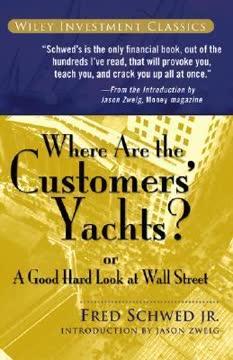
In the early 1900s, a visitor to New York City was being shown the financial district. His guide pointed out the magnificent yachts owned by the bankers and brokers, then turned to the harbor and said, "Look at all those beautiful boats. The bankers' yachts, the brokers' yachts, the financiers' yachts." The visitor paused, looked around, and asked a question that has echoed through the decades: "Where are the customers' yachts?" This story, likely apocryphal but endlessly revealing, gives Fred Schwed Jr. his title and his central theme. The financial industry exists, at least in part, to enrich the people who work in it. The customers, the ordinary investors who provide the capital and pay the fees, often end up with considerably less to show for their efforts. Schwed wrote this book in 1940, after the Great Depression had wiped out fortunes and exposed the hollow promises of Wall Street. He had worked as a trader and broker himself, so he knew exactly how the game was played from the inside. His book is funny, irreverent, and occasionally devastating in its honesty. It remains in print more than eighty years later because the behaviors it describes have not changed. Markets still boom and crash. Brokers still collect commissions. Investors still chase dreams of easy wealth. And the customers still wonder where their yachts went. The problem Schwed addresses is not simply that Wall Street is greedy. Greed is common everywhere. The deeper problem is that most people approach investing with a set of beliefs that are almost perfectly designed to make them lose money. They believe that experts can predict the future. They believe that there is a secret method that will beat the market. They believe that if they just work hard enough at picking stocks, they will succeed. They believe that the financial industry has their best interests at heart. None of these beliefs survive contact with reality. Schwed's approach is different because he does not pretend to have the answers. He does not offer a…
Continue reading in the MinuteRead app
Get the complete 30-minute summary of Where Are the Customers' Yachts?
Get the complete summary in the appWall Street is designed to make Wall Street rich, not you.
You cannot predict the market. Neither can the experts.
Speculation is a game you are unlikely to win.
Investment is ownership of productive assets held for the long term.
Compound interest is the most powerful force in finance. Give it time.
Leverage is the most common cause of financial ruin. Avoid it.
"Where Are the Customers' Yachts?" is a strong fit if you want practical ideas around finance, business, economics, especially themes like wall street is designed to make wall street rich, not you; you cannot predict the market. neither can the experts. The MinuteRead summary distills these concepts into a focused read, whether you're deciding whether to buy the book or applying its lessons at work.
Fred Schwed Jr. was an American financial writer and former Wall Street trader. He gained fame for his satirical take on the financial industry, particularly with his book "Where Are the Customers' Yachts?" published in 1940. Schwed's work is known for its humorous yet insightful critique of Wall Street practices and the behavior of investors. His writing style combines wit, irony, and keen observations, making complex financial concepts accessible to the general public. Schwed's background as a…
View all summaries by Fred Schwed Jr.Continue Reading
Access the complete 30-minute summary and thousands more nonfiction books in the MinuteRead app.

Continue reading the complete summary in the MinuteRead app.