MinuteRead
30 min
Book summary
Premium summary · Opens in the app · 30 min read
Every year, millions of people hand their hard-earned money to professional money managers with the same expectation: these experts will beat the market. They believe that skill, research, and experience will produce returns above what a simple index fund could deliver. They pay fees for this expertise. They trust that the professionals know something the rest of us do not.
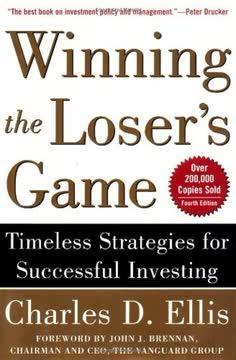
**Author:** Charles D. Ellis
**Estimated Reading Time:** 45 minutes
**What You'll Learn:** - Why most professional investors fail to beat the market - How to build a portfolio that actually works for you - The psychology behind costly investment mistakes - How to think about risk, time, and compounding - A practical framework for lifelong investing success
**Who This Book Is For:** Individual investors who want to stop playing a losing game. Retirement savers who need a clear, proven strategy. Anyone who has ever wondered why their actively managed funds underperform. And professionals who suspect the industry they work in has been selling an illusion.
Every year, millions of people hand their hard-earned money to professional money managers with the same expectation: these experts will beat the market. They believe that skill, research, and experience will produce returns above what a simple index fund could deliver. They pay fees for this expertise. They trust that the professionals know something the rest of us do not. Charles Ellis spent decades at the center of the investment industry. He founded Greenwich Associates, a consulting firm that advised the biggest financial institutions in the world. He taught at Harvard and Yale. He served on the board of directors of the Vanguard Group. He has seen the industry from every angle: the trading desks, the boardrooms, the academic research, and the actual performance numbers. What he discovered changed his entire view of investing. The investment management business, Ellis argues, is built on a premise that was once reasonable but is now obsolete. Fifty years ago, individual investors dominated the market. Amateurs made obvious mistakes. Professional managers with better information and discipline could exploit those mistakes and deliver superior returns. The game was winnable. Today, the game has changed completely. The amateurs have largely left the field. Institutional investors now account for the overwhelming majority of trading volume. The people sitting across the table from your fund manager are not naive individuals making emotional decisions. They are other professionals with the same credentials, the same information, and the same tools. The competition is no longer between experts and amateurs. It is between experts and experts. This shift has profound implications. When everyone at the table is highly skilled, the advantage of skill disappears. The game becomes a contest of who makes fewer mistakes rather than who makes more brilliant moves. In tennis, Ellis explains, there are two ways to win. The professional game is won by hitting winners: powerful, precise shots that your opponent cannot return. The amateur game is won differently. Amateurs lose by hitting the ball into the net or out of bounds. The winner is simply the player who makes fewer errors.…
Continue reading in the MinuteRead app
Get the complete 30-minute summary of Winning the Loser's Game, Seventh Edition
Get the complete summary in the app**Stop trying to beat the market.** The game has changed. Most active managers fail to beat their benchmarks. Buy the ma
**Start investing today.** Time is your most powerful ally. Even small amounts invested early can grow into substantial
**Focus on asset allocation.** The mix of stocks, bonds, and cash in your portfolio is the most important investment dec
**Minimize fees.** A 1 percent fee can reduce your portfolio's value by nearly 30 percent over 30 years. Choose low-cost
**Manage your emotions.** The hardest part of investing is emotional, not intellectual. Write an investment policy and s
**Avoid large losses.** A 50 percent loss requires a 100 percent gain to break even. Diversify your portfolio and manage
"Winning the Loser's Game, Seventh Edition" is a strong fit if you want practical ideas around finance, business, economics, especially themes like **stop trying to beat the market.** the game has changed. most active managers fail to beat their benchmarks. buy the ma; **start investing today.** time is your most powerful ally. even small amounts invested early can grow into substantial. The MinuteRead summary distills these concepts into a focused read, whether you're deciding whether to buy the book or applying its lessons at work.
Charles D. Ellis is an American investment consultant and founder of Greenwich Associates, a strategy consulting firm for financial institutions. He is renowned for his advocacy of passive investing through index funds, as outlined in his book "Winning the Loser's Game." Ellis's philosophy challenges the notion of actively managed funds, arguing that most investors are better served by low-cost index funds. His work has significantly influenced the investment industry, promoting a focus on long-…
View all summaries by Charles D. EllisContinue Reading
Access the complete 30-minute summary and thousands more nonfiction books in the MinuteRead app.

Continue reading the complete summary in the MinuteRead app.