 MinuteRead
30 min
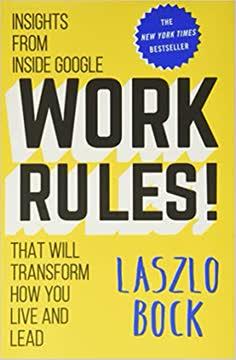
Book summary
by Laszlo Bock
Premium summary · Opens in the app · 30 min read
Most companies treat people as a problem to be managed. They build elaborate systems to control what employees do, monitor how they perform, and constrain what they can access. They assume people need supervision, that information must be guarded, and that hierarchy is the natural order of things. The result is workplaces where talented adults are treated like children, where creativity is suffocated by process, and where the best people eventually leave.
**Author:** Laszlo Bock **Estimated Reading Time:** 45 minutes
**What You'll Learn:**
Why Google's approach to people management produces extraordinary results, how to hire better than anyone else, what truly motivates talented people, how to build a culture where transparency and trust drive innovation, and how to apply these principles in any organization.
**Who This Book Is For:**
Managers who want to build high-performing teams, founders who need to create a culture from scratch, HR professionals looking for a better way, and anyone who has ever wondered why work feels broken and whether it could be different.
Most companies treat people as a problem to be managed. They build elaborate systems to control what employees do, monitor how they perform, and constrain what they can access. They assume people need supervision, that information must be guarded, and that hierarchy is the natural order of things. The result is workplaces where talented adults are treated like children, where creativity is suffocated by process, and where the best people eventually leave. Laszlo Bock spent over a decade running Google's People Operations, the function most companies call Human Resources. During that time, Google grew from a few thousand employees to tens of thousands, expanded across the globe, and consistently ranked as one of the best places to work in the world. But more importantly, Google became a laboratory for a radical idea: that if you treat people with trust and respect, if you give them real freedom and real information, they will do extraordinary things. The premise of this book is simple but profound. Most management practices are built on a foundation of distrust. We assume people will slack off without supervision, so we monitor them. We assume they will leak secrets, so we restrict information. We assume they will make bad decisions, so we centralize authority. Each assumption becomes a self-fulfilling prophecy. When you treat people as untrustworthy, they respond by disengaging. When you restrict information, people stop caring about outcomes. When you centralize authority, people stop thinking for themselves. Bock argues for the opposite approach. Start from the belief that people are fundamentally good, that they want to do meaningful work, and that they will rise to the level of trust you place in them. Build systems that reflect that belief. Hire people who are better than you. Give them information that most companies would consider dangerous to share. Pay them based on the value they create, not their position in a hierarchy. Let them teach each other, experiment freely, and make mistakes without fear. This is not soft idealism. Bock is deeply analytical, drawing on behavioral economics, psychology, and data from Google's own experiments. He shows that trust-based management produces measurable…
Continue reading in the MinuteRead app
Get the complete 30-minute summary of Work Rules!
Get the complete summary in the appStart from the belief that people are fundamentally good, and build systems that reflect that belief.
Treat hiring as the highest-leverage activity in your organization. Only hire people who are better than you.
Default to transparency. Share information unless there is a compelling reason not to.
Give people freedom and authority. If you're not nervous, you haven't given them enough.
Pay for impact, not tenure. Your best people are worth more than you pay them.
Separate development conversations from performance evaluations.
"Work Rules!" is a strong fit if you want practical ideas around business, leadership, management, especially themes like start from the belief that people are fundamentally good, and build systems that reflect that belief; treat hiring as the highest-leverage activity in your organization. only hire people who are better than you. The MinuteRead summary distills these concepts into a focused read, whether you're deciding whether to buy the book or applying its lessons at work.
Laszlo Bock leads Google's people operations, focusing on creating a positive work environment for employees. He believes in giving people freedom and using data to inform decision-making. Bock's book, Work Rules!, has received recognition from various publications. Under his leadership, Google has been named a top employer numerous times. Bock has diverse experience, including roles at General Electric and McKinsey & Company. He has testified before Congress on labor issues and been featured in…
View all summaries by Laszlo BockContinue Reading
Access the complete 30-minute summary and thousands more nonfiction books in the MinuteRead app.

Continue reading the complete summary in the MinuteRead app.






