MinuteRead
30 min
Book summary
Premium summary · Opens in the app · 30 min read
Economics is often called the dismal science, a phrase coined by the Victorian historian Thomas Carlyle. The label has stuck, and for many people it feels deserved. Economics seems abstract, mathematical, and disconnected from everyday life. It appears to be the domain of experts who speak in jargon and disagree with one another constantly. Yet few subjects matter more for understanding the world we inhabit.
**Author:** Tom Butler-Bowdon
**Estimated Reading Time:** 45 minutes
**What You'll Learn:**
- The most influential economic ideas that have shaped the modern world - How thinkers from Adam Smith to Joseph Stiglitz have understood wealth, markets, and human behavior - The recurring tensions between free markets and government intervention - Why economic ideas matter for your personal decisions, your career, and your understanding of global events - The critical debates that continue to define economic policy today
**Who This Book Is For:**
This condensed edition is for anyone who wants to understand the economic forces that shape our lives but feels intimidated by dense academic texts. Whether you are a student, a professional, a business owner, or simply a curious reader, this book will give you a foundation in the ideas that drive markets, governments, and societies. No prior knowledge of economics is required.
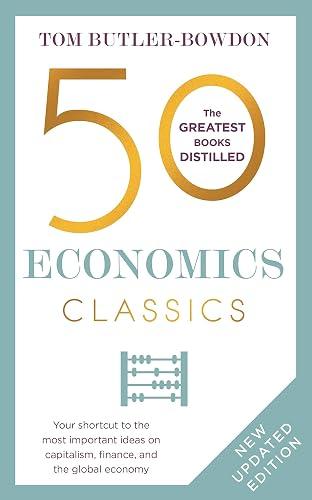
Economics is often called the dismal science, a phrase coined by the Victorian historian Thomas Carlyle. The label has stuck, and for many people it feels deserved. Economics seems abstract, mathematical, and disconnected from everyday life. It appears to be the domain of experts who speak in jargon and disagree with one another constantly. Yet few subjects matter more for understanding the world we inhabit. Every time you check the price of groceries, apply for a job, pay taxes, or wonder why some countries are rich while others remain poor, you are confronting economic questions. The decisions made by central bankers affect your mortgage rate. The trade policies negotiated by governments affect the products on store shelves. The economic theories embraced by policymakers determine whether millions of people find work or lose their jobs. Tom Butler-Bowdon's "50 Economics Classics" addresses a fundamental problem: most people never read the great economic thinkers because the original works are long, technical, and often written in language that assumes prior knowledge. Adam Smith's "The Wealth of Nations" runs to over a thousand pages. Karl Marx's "Capital" is even longer and notoriously difficult. John Maynard Keynes wrote for fellow economists, not general readers. The result is that economic ideas circulate through society in simplified, often distorted forms. People argue about capitalism, socialism, free trade, and inequality without having read the foundational texts that shaped these concepts. This book exists to bridge that gap. Butler-Bowdon has distilled fifty of the most important economics books ever written into accessible chapters that capture the essence of each work. He covers the full sweep of economic thought, from Adam Smith's invisible hand to Thomas Piketty's analysis of inequality, from Milton Friedman's monetarism to Daniel Kahneman's behavioral economics. Each chapter explains what the author argued, why it mattered, and how the ideas continue to influence our…
Continue reading in the MinuteRead app
Get the complete 30-minute summary of 50 Economics Classics
Get the complete summary in the appWealth is created through the division of labor and specialization, not through the accumulation of gold or money.
Trade benefits all participants through comparative advantage, even when one party is more efficient at everything.
Markets are powerful tools for coordinating economic activity, but they can fail in important cases.
Capitalism is dynamic and disruptive, progressing through creative destruction that creates winners and losers.
Economies can become stuck at high unemployment, and government intervention may be necessary to restore full employment
Human decision-making is systematically irrational, subject to biases that affect economic choices.
"50 Economics Classics" is a strong fit if you want practical ideas around economics, finance, business, especially themes like wealth is created through the division of labor and specialization, not through the accumulation of gold or money; trade benefits all participants through comparative advantage, even when one party is more efficient at everything. The MinuteRead summary distills these concepts into a focused read, whether you're deciding whether to buy the book or applying its lessons at work.
Motivated to help readers with "It is hard for an economic federation to work if the different members of the federation have different, Tom Butler-Bowdon wrote “50 Economics Classics” to package those ideas for a fast, focused read. In “50 Economics Classics”, Tom Butler-Bowdon focuses on "It is hard for an economic federation to work if the different members of the federation have different. Through “50 Economics Classics”, Tom Butler-Bowdon distills the core ideas on economics into lessons re…
View all summaries by Tom Butler-BowdonContinue Reading
Access the complete 30-minute summary and thousands more nonfiction books in the MinuteRead app.

Continue reading the complete summary in the MinuteRead app.