MinuteRead
30 min
Book summary
Premium summary · Opens in the app · 30 min read
There is a vast and largely invisible industry devoted to selling you a false picture of your own mind. It operates through blockbuster movies, self-help bestsellers, television documentaries, motivational seminars, and casual conversation. It tells you that you are using only a fraction of your brain's potential. It assures you that listening to Mozart will make you smarter. It warns you that subliminal messages hidden in advertisements are controlling your purchasing decisions. It promises tha
**Author:** Scott O. Lilienfeld
**Estimated Reading Time:** 45 minutes
**What You'll Learn:**
Why most of what you believe about the human mind is wrong, how these myths took root, and what the scientific evidence actually shows about how we think, feel, remember, and behave.
**Who This Book Is For:**
Anyone who has ever wondered whether we really use only 10 percent of our brains, whether opposites truly attract, or whether hypnosis can make people act against their will. This book is for curious readers who want to replace comfortable illusions with accurate knowledge.
There is a vast and largely invisible industry devoted to selling you a false picture of your own mind. It operates through blockbuster movies, self-help bestsellers, television documentaries, motivational seminars, and casual conversation. It tells you that you are using only a fraction of your brain's potential. It assures you that listening to Mozart will make you smarter. It warns you that subliminal messages hidden in advertisements are controlling your purchasing decisions. It promises that hypnosis can unlock buried memories and reveal hidden truths. Almost none of this is true. Scott O. Lilienfeld, a clinical psychologist and professor at Emory University, spent his career investigating the gap between what the public believes about psychology and what psychological research actually demonstrates. What he found was troubling. In survey after survey, large majorities of people endorse claims about the mind that have been thoroughly debunked by decades of scientific research. These beliefs are not harmless curiosities. They shape how people raise their children, how they make decisions about their health, how they evaluate criminal testimony, and how they understand their own suffering. The problem is not that people are foolish. The problem is that psychological myths are exceptionally good at surviving. They are intuitive. They feel true. They offer simple explanations for complex phenomena. They promise hidden potential and easy solutions. And they are repeated so often, in so many contexts, that they become part of the cultural furniture. We absorb them without ever stopping to ask whether they are actually supported by evidence. Consider the claim that we use only 10 percent of our brains. This idea has appeared in movies like *Lucy* and *Limitless*, in countless self-help books, and in the promotional materials of programs that promise to unlock your hidden mental powers. It is a compelling idea. It suggests that we are all secretly geniuses, held back only by our failure to access dormant neural territory. But as Lilienfeld explains, the claim is biologically absurd. Brain tissue is metabolically expensive. It consumes roughly 20 percent of the oxygen we breathe despite accounting for only 2 to 3 percent of our body weight. Evolution does not waste…
Continue reading in the MinuteRead app
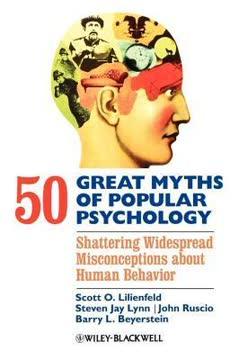
Get the complete 30-minute summary of 50 Great Myths of Popular Psychology
Get the complete summary in the appYou use all of your brain, not just 10 percent of it.
Memory is reconstructive, not a perfect recording.
The polygraph detects arousal, not lies.
Similarity attracts, not opposites.
Venting anger makes it worse, not better.
Learning styles are a myth.
"50 Great Myths of Popular Psychology" is a strong fit if you want practical ideas around psychology, science, self help, especially themes like you use all of your brain, not just 10 percent of it; memory is reconstructive, not a perfect recording. The MinuteRead summary distills these concepts into a focused read, whether you're deciding whether to buy the book or applying its lessons at work.
Scott O. Lilienfeld is a prominent psychologist and professor at Emory University. He is known for his work in clinical psychology, personality disorders, and pseudoscience in mental health. Lilienfeld has authored numerous books and articles challenging popular misconceptions in psychology. His research focuses on evidence-based practices and the application of scientific thinking to psychological issues. He is a vocal critic of questionable therapeutic techniques and has contributed significan…
View all summaries by Scott O. LilienfeldContinue Reading
Access the complete 30-minute summary and thousands more nonfiction books in the MinuteRead app.

Continue reading the complete summary in the MinuteRead app.