MinuteRead
30 min
Book summary
Premium summary · Opens in the app · 5 min read
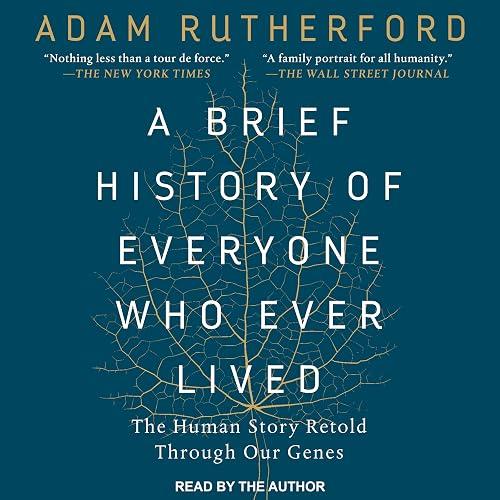
A Brief History Of Everyone Who Ever Lived gives you another important perspective on mankind’s past and present through the lens of our genes.
A Brief History Of Everyone Who Ever Lived gives you another important perspective on mankind’s past and present through the lens of our genes.
Did you know changes in human culture can be found in our genes? Take milk, for example. While some people enjoy it on a daily basis, most adults are actually lactose intolerant. Have you ever wondered why?
The enzyme responsible for breaking down lactose, lactase, is coded into our genes and actually disappears after we are infants. But somewhere along the line, a mutation resulted in it staying throughout adult life. This happened in Europeans, and this is why those of European ancestry were able to enjoy milk, which lead to the cultural practice of dairy farming.
Other groups in Africa and Asia also developed the ability to keep lactase. It’s likely these genes mutated because it was evolutionarily advantageous to be able to digest lactose.
Environment can also change our genes. It’s thought that all humans originated from Africa, and everyone had dark skin. The people that migrated to Europe 50,000 years ago also had dark skin. How did they end up with the lighter skin they have today?
Dark skin was an adaptation to the sunny weather. We can see that the people who migrated to Sweden had a change in their skin around 7,700 years ago. Their genes acted together to produce lighter hair, skin, and eyes as an adaptation to less light.
If you’re like me, you may have seen your family tree trace back to someone royal, like Charlamagne. Pretty impressive, right? Sorry to burst your bubble, but everyone’s lineage traces back to royalty. And here’s why.
Joseph Chang, a statistician at Yale, looked at ancestry through numbers. He wanted to find how far back you needed to go to find a common ancestor for all Europeans. The answer? Just 600 years. Every European line crosses around the time of Richard II of England.
It seems impossible considering the amount of Europeans alive today because they must have billions and billions of ancestors, right?
Well, there weren’t that many Europeans just a thousand years ago. Every European that is alive today descended from literally every person that was alive in the ninth century. Many of those people fill multiple spots on a family tree, and so Charlamagne, who fathered 18 children, is on every tree of Europeans alive today.
Similarly, Genghis Khan is a common ancestor on all Asian family trees, and Nefertiti is the same for Africans. All across the world, on every family tree, everyone is related to some ancient royalty.
Continue reading in the MinuteRead app
Get the complete 5-minute summary of A Brief History Of Everyone Who Ever Lived
Get the complete summary in the appHuman culture and the environment can affect our genes as they did so for our ancient ancestors.
Royalty is in the family tree of everyone on earth.
We understand a lot more about the human genome after deciphering it in the year 2000.
"A Brief History Of Everyone Who Ever Lived" is a strong fit if you want practical ideas around culture, history, science, especially themes like human culture and the environment can affect our genes as they did so for our ancient ancestors; royalty is in the family tree of everyone on earth. The MinuteRead summary distills these concepts into a focused read, whether you're deciding whether to buy the book or applying its lessons at work.
Hello, I'm Dr Adam Rutherford, a science writer and broadcaster. I studied genetics at University College London, and during my PhD on the developing eye at the Institute of Child Health at Great Ormond St Hospital, I was part of a team that identified the first genetic cause of a form of childhood blindness. Since then, I worked as an editor at the journal Nature, and have written several books; my first book, CREATION, on the origin of life and synthetic biology, was shortlisted for the Wellco…
View all summaries by Adam RutherfordContinue Reading
Access the complete 5-minute summary and thousands more nonfiction books in the MinuteRead app.

Continue reading the complete summary in the MinuteRead app.