MinuteRead
30 min
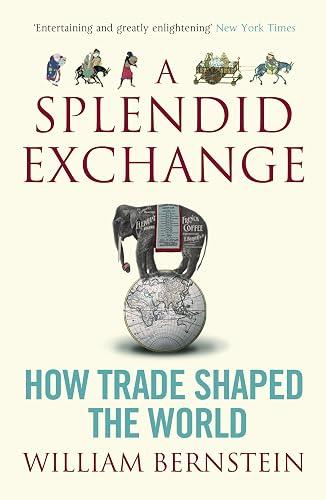
A Splendid Exchange outlines the history of global trade, revealing its older than we think, has enabled the progress of civilization, and continues to change the world on a daily basis.
A Splendid Exchange outlines the history of global trade, revealing its older than we think, has enabled the progress of civilization, and continues to change the world on a daily basis.
There is a place in modern-day Iraq that is called the cradle of civilization. In the middle of nowhere, between two rivers that reconnect at the Persian Gulf, the Euphrates and the Tigris, lies our ancient history. Then called Mesopotamia, this was one of the first urban hubs in the world.
Lying between two rivers, hence the term ‘cradle,’ Mesopotamia was rich in barley, fish, wool and other farmable products. What it lacked, however, was building materials to create its infrastructure – houses, paths, shelter, and so on. As early as 3,000 BC, they decided to try and exchange their surplus of farm goods for those materials, like lumber, marble, and precious metals. They began trading with Persia, Oman and Lebanon and soon, the Persian Gulf was a center of commerce!
However, the very first long-distance trade happened a lot earlier still, around 12,000 BC. It also originated from Mesopotamia, but involved a different export: Obsidian stone. We don’t know why and what it was traded for, but researchers found the rare, black material, that is today often used for decorative elements and in expensive floors, in a cave in Greece, over 2,000 miles away from its source.
In the Middle Ages, wealthy royals showed off their power in the form of huge castles and pompous decor. But there was another vice of the rich that could never be flaunted for long: spices. Salt, pepper, cinnamon, all of these were incredibly rare in Europe, so dangerous journeys had to be taken to get them. That’s why merchants often sold them for a cool 100% in profit and doctors all added them to their medicines, even though they didn’t do anything.
The rise in spice trade had its price, however. One, because European merchants often traded slaves to Arab countries for it, and two, because alongside their spices, they imported something else entirely: the plague. The Black Death reduced the global population by as much as 20%, wiping out up to half of Europe. We would not see those population levels again for 400 years.
This disease likely originated in the Himalayas in China and took years to spread, but imagine something like this happened today. True, our hygiene and medical care is exponentially better, but we’re also much more connected, so viruses can spread a lot faster. If you’re fascinated by this, the movie Contagion gives a good idea.
What’s the lesson? You never just trade item A for item B. There are always other factors involved.
Continue reading in the MinuteRead app
Get the complete 5-minute summary of A Splendid Exchange
Get the complete summary in the appThe first item traded long-distance was…a stone.
Trading always involves more goods than just the traded items and sometimes, they can be deadly.
One of the biggest enablers of transcontinental trade had nothing to do with transportation.
"A Splendid Exchange" is a strong fit if you want practical ideas around culture, entrepreneurship, history, especially themes like the first item traded long-distance was…a stone; trading always involves more goods than just the traded items and sometimes, they can be deadly. The MinuteRead summary distills these concepts into a focused read, whether you're deciding whether to buy the book or applying its lessons at work.
William Bernstein has authored several best-selling books on finance and history, is often quoted in the national financial media, and has written for Morningstar, Money Magazine, and The Wall Street Journal. His title on the history of world trade, A Splendid Exchange, was short-listed for the 2008 Financial Times/Goldman Sachs best business book award, and was designated a best book of the year by the Economist. He was the 2017 recipient of the CFA Institute's James Vertin Award for financial …
View all summaries by William J. BernsteinContinue Reading
Access the complete 5-minute summary and thousands more nonfiction books in the MinuteRead app.

Continue reading the complete summary in the MinuteRead app.