MinuteRead
30 min
Book summary
Premium summary · Opens in the app · 30 min read
Human beings are pattern-seeking creatures. We evolved on the African savanna, where survival depended on recognizing the familiar: the shape of a predator in the grass, the rhythm of seasons, the predictable arc of the sun. Our brains were built for the scale of a human life, measured in decades, across distances measured in miles, at speeds measured in strides.
**Author:** Neil deGrasse Tyson
**Estimated Reading Time:** 45 minutes
**What You'll Learn:**
- The true scale and strangeness of the cosmos - How stars forge the elements that make life possible - Why the search for extraterrestrial intelligence is more nuanced than you think - What lurks at the center of our galaxy - How the universe began, how it is evolving, and how it might end - What the future may hold for humanity among the stars
**Who This Book Is For:**
Anyone who has ever looked up at the night sky and felt both wonder and confusion. You do not need a physics degree to understand this book. You need curiosity, a willingness to have your intuition challenged, and an openness to discovering that reality is far stranger than fiction.
Human beings are pattern-seeking creatures. We evolved on the African savanna, where survival depended on recognizing the familiar: the shape of a predator in the grass, the rhythm of seasons, the predictable arc of the sun. Our brains were built for the scale of a human life, measured in decades, across distances measured in miles, at speeds measured in strides. The universe cares nothing for our intuitions. When we turn our attention to the cosmos, every instinct we have fails us. The distances are so vast that our standard units become meaningless. The temperatures are so extreme that matter itself behaves in ways we can barely comprehend. The densities are so crushing that a teaspoon of certain stellar material would outweigh a mountain. And the timescales stretch so far into the past and future that human history becomes a blink, a flicker, a momentary spark in an ocean of time. This is the challenge at the heart of astrophysics. It is not merely that the universe is big. It is that the universe is deeply, fundamentally alien to human experience. Yet it is also our home. We are made of its atoms, governed by its laws, and shaped by its history. The calcium in your bones was forged in the heart of a dying star. The iron in your blood came from a supernova explosion billions of years ago. You are, in the most literal sense, a child of the cosmos. Neil deGrasse Tyson has spent his career bridging the gap between human intuition and cosmic reality. As an astrophysicist and science communicator, he understands that the greatest barrier to understanding the universe is not mathematics or physics. It is the assumption that the universe should make sense to us, that it should conform to our everyday expectations. In this book, Tyson and his colleagues invite you to abandon that assumption. They invite you to embrace the strangeness,…
Continue reading in the MinuteRead app
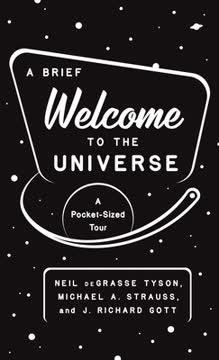
Get the complete 30-minute summary of A Brief Welcome to the Universe
Get the complete summary in the appThe universe is far more exotic than human intuition suggests. Everything you think about the cosmos is less strange tha
The observable universe contains about ten thousand billion billion stars across hundreds of billions of galaxies.
Stars forge the elements that make life possible. The atoms in your body were created in stellar cores and supernova exp
Pluto is not a planet. It is the largest known Kuiper Belt object, the first discovered member of a new category of icy
The Drake Equation organizes our knowledge and ignorance about the search for extraterrestrial life. We simply do not kn
A supermassive black hole with the mass of four million suns sits at the center of the Milky Way.
"A Brief Welcome to the Universe" is a strong fit if you want practical ideas around science, physics, space, especially themes like the universe is far more exotic than human intuition suggests. everything you think about the cosmos is less strange tha; the observable universe contains about ten thousand billion billion stars across hundreds of billions of galaxies. The MinuteRead summary distills these concepts into a focused read, whether you're deciding whether to buy the book or applying its lessons at work.
Neil deGrasse Tyson is a renowned astrophysicist, author, and science communicator. Born and raised in New York City, he earned degrees from Harvard and Columbia. Tyson has served on various space-related commissions and advisory councils. He's written numerous books, including bestsellers, and hosted popular science shows like NOVA ScienceNOW and StarTalk. Tyson is known for his ability to make complex scientific concepts accessible to the public. He's received multiple honorary doctorates and …
View all summaries by Neil deGrasse TysonContinue Reading
Access the complete 30-minute summary and thousands more nonfiction books in the MinuteRead app.

Continue reading the complete summary in the MinuteRead app.