MinuteRead
30 min
Book summary
Premium summary · Opens in the app · 30 min read
We hold a quiet but powerful assumption about leadership. We believe that the best leaders are the healthiest ones. We want our presidents, prime ministers, and generals to be stable, balanced, and psychologically sound. We equate mental health with good judgment, and mental illness with danger and incompetence. This assumption feels so obvious that we rarely stop to examine it.
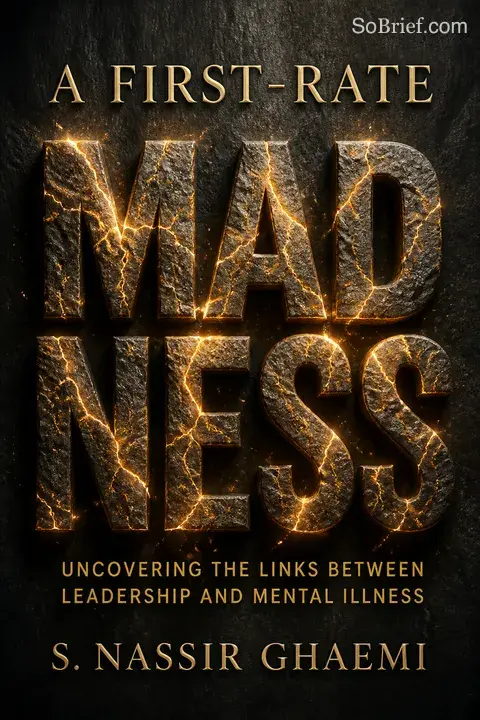
**Uncovering the Links Between Leadership and Mental Illness**
**By S. Nassir Ghaemi**
**Estimated Reading Time:** 45 minutes
**What You'll Learn:** Why the leaders who guide us through the deepest crises are often not the most mentally healthy among us. You will discover the hidden advantages that depression, mania, and hyperthymic temperament confer upon leaders facing turmoil, and why our preference for “normal” and “stable” personalities can be a dangerous liability in times of upheaval.
**Who This Book Is For:** Anyone who has ever wondered what makes a great leader, anyone who has struggled with mental illness or loves someone who has, and anyone who wants to understand why history’s most transformative figures were often also its most troubled.
We hold a quiet but powerful assumption about leadership. We believe that the best leaders are the healthiest ones. We want our presidents, prime ministers, and generals to be stable, balanced, and psychologically sound. We equate mental health with good judgment, and mental illness with danger and incompetence. This assumption feels so obvious that we rarely stop to examine it. S. Nassir Ghaemi, a professor of psychiatry at Tufts Medical Center and Harvard Medical School, argues that this assumption is not just wrong. It is dangerously wrong. In times of crisis, the very qualities we fear in mental illness become essential. The realism of depression, the creativity of mania, and the resilience born of suffering are not liabilities. They are the raw materials of transformative leadership. The problem is that we have built a society that selects for the wrong kind of leader. We reward the calm, the steady, the conventionally successful. We gravitate toward those who make us feel safe with their optimism and their easy confidence. These “homoclites,” as Ghaemi calls them, are excellent stewards of peace and prosperity. But when the world breaks, when the old rules no longer apply, their sanity becomes a cage. They cannot see what must be seen, and they cannot do what must be done. This book is not a celebration of mental illness. Ghaemi is a clinician who has spent his career treating the devastating effects of depression and bipolar disorder. He knows the suffering these conditions cause. He does not romanticize them. But he insists that we look at them honestly, without the distorting lens of stigma. When we do, a surprising pattern emerges. Many of history’s greatest crisis leaders were mentally ill or mentally abnormal. Abraham Lincoln suffered from severe, lifelong depression. Winston Churchill called his own depression the “black dog.” Mahatma Gandhi and Martin Luther King Jr. both attempted suicide as adolescents. John F. Kennedy and Franklin D. Roosevelt lived with serious medical and psychological challenges that shaped their leadership…
Continue reading in the MinuteRead app
Get the complete 30-minute summary of A First-Rate Madness
Get the complete summary in the appThe Inverse Law of Sanity: Mentally healthy leaders excel in stable times. Mentally ill or abnormal leaders excel in cri
Depression enhances realism. Depressed people see reality more accurately than the mentally healthy.
Mania and hyperthymia enhance creativity. They generate novel solutions and the energy to pursue them.
Suffering deepens empathy. Personal experience of pain allows leaders to understand and connect with the suffering of ot
Resilience is built through manageable adversity. The steeling effect turns hardship into strength.
Homoclites, the mentally healthy and conventional, often fail in crises because they cannot see beyond their assumptions
"A First-Rate Madness" is a strong fit if you want practical ideas around psychology—especially themes like the inverse law of sanity: mentally healthy leaders excel in stable times. mentally ill or abnormal leaders excel in cri; depression enhances realism. depressed people see reality more accurately than the mentally healthy. The MinuteRead summary distills these concepts into a focused read, whether you're deciding whether to buy the book or applying its lessons at work.
Nassir Ghaemi MD MPH is an academic psychiatrist specializing in mood disorders. He is a Professor of Psychiatry at Tufts Medical Center and a Clinical Lecturer at Harvard Medical School. Born in Iran and raised in Virginia, Ghaemi has published extensively on depression and bipolar illness, with over 200 scientific articles and several books. He holds degrees in medicine, philosophy, and public health. Ghaemi is an Associate Editor of Acta Psychiatrica Scandinavica and a Distinguished Fellow of…
View all summaries by S. Nassir GhaemiContinue Reading
Access the complete 30-minute summary and thousands more nonfiction books in the MinuteRead app.

Continue reading the complete summary in the MinuteRead app.