MinuteRead
30 min
Book summary
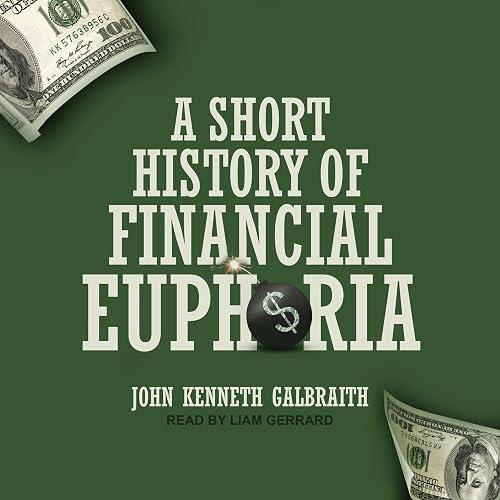
by John Kenneth Galbraith
Premium summary · Opens in the app · 30 min read
In 1636, Dutch citizens traded entire estates for single tulip bulbs. In 1720, English lords and ladies bankrupted themselves buying shares in companies with no assets and no clear purpose. In 1929, shoe-shine boys offered stock tips to Wall Street bankers. In 1987, portfolio managers watched billions evaporate in hours, stunned that their sophisticated models had failed to predict what history had demonstrated repeatedly for centuries.
**Author:** John Kenneth Galbraith
**Estimated Reading Time:** 45 minutes
**What You'll Learn:**
- Why financial manias have repeated with astonishing consistency for over four centuries - The psychological forces that turn intelligent individuals into reckless speculators - How leverage transforms modest investments into catastrophic collapses - Why financial memory resets approximately every twenty years - What history reveals about the inevitability of future speculative episodes
**Who This Book Is For:**
Anyone who has ever felt the pull of a rising market, wondered why smart people make foolish financial decisions, or suspected that the latest investment craze might not be different this time. This book is for investors, students of history, and anyone seeking to understand the recurring patterns of financial madness that shape economies and societies.
In 1636, Dutch citizens traded entire estates for single tulip bulbs. In 1720, English lords and ladies bankrupted themselves buying shares in companies with no assets and no clear purpose. In 1929, shoe-shine boys offered stock tips to Wall Street bankers. In 1987, portfolio managers watched billions evaporate in hours, stunned that their sophisticated models had failed to predict what history had demonstrated repeatedly for centuries. John Kenneth Galbraith wrote A Short History of Financial Euphoria to address a puzzle that has confounded economists, historians, and ordinary citizens alike. The puzzle is not that financial speculation exists. The puzzle is that it keeps happening in essentially the same form, generation after generation, despite the enormous cost of each episode. The puzzle is that intelligent people, armed with historical knowledge and sophisticated analytical tools, continue to believe that this time is different. Galbraith approaches this subject with a distinctive blend of wit, erudition, and moral clarity. He was not merely an academic economist. He served in multiple presidential administrations, witnessed the Great Depression firsthand, and spent decades observing the intersection of money, power, and human folly. His perspective is that of a man who has seen too much to be impressed by claims of financial innovation, and too wise to believe that prosperity can be engineered through collective enthusiasm. The problem this book addresses is not primarily economic. It is psychological. Financial euphoria, Galbraith argues, is a mass delusion. It is a state in which otherwise rational individuals abandon their judgment and surrender to the collective conviction that wealth can be created without effort, that prices can rise indefinitely, and that the laws of economic gravity have been suspended. This is not a failure of intelligence. It is a failure of memory and a triumph of hope over experience. The topic matters because the consequences of financial euphoria extend far beyond the fortunes of individual speculators. When bubbles collapse, they take down banks, businesses, and…
Continue reading in the MinuteRead app
Get the complete 30-minute summary of A Short History of Financial Euphoria
Get the complete summary in the appFinancial euphoria is a recurring pattern driven by human psychology, not a random event.
Every speculative bubble ends in a sudden and severe collapse.
Financial memory lasts at most twenty years. Each generation repeats the mistakes of the past.
Leverage amplifies both gains and losses, turning corrections into crashes.
Financial innovation is usually repackaging, not genuine progress.
The belief that this time is different is always wrong.
"A Short History of Financial Euphoria" is a strong fit if you want practical ideas around economics, finance, history, especially themes like financial euphoria is a recurring pattern driven by human psychology, not a random event; every speculative bubble ends in a sudden and severe collapse. The MinuteRead summary distills these concepts into a focused read, whether you're deciding whether to buy the book or applying its lessons at work.
Motivated to help readers with "Anyone taken as an individual is tolerably sensible and reasonable—as a member of a crowd, John Kenneth Galbraith wrote “A Short History of Financial Euphoria” to package those ideas for a fast, focused read. In “A Short History of Financial Euphoria”, John Kenneth Galbraith focuses on "Anyone taken as an individual is tolerably sensible and reasonable—as a member of a crowd. Through “A Short History of Financial Euphoria”, John Kenneth Galbraith distills the core…
Continue Reading
Access the complete 30-minute summary and thousands more nonfiction books in the MinuteRead app.

Continue reading the complete summary in the MinuteRead app.