MinuteRead
30 min
Book summary
Premium summary · Opens in the app · 5 min read
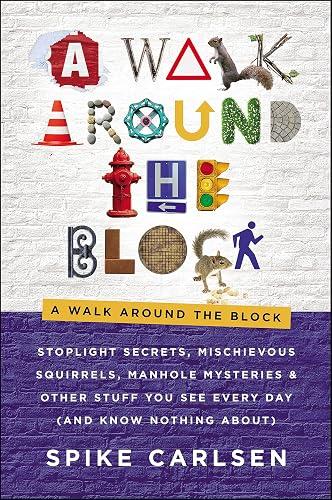
A Walk Around the Block is a beautiful, local-neighborhood exploration of where “the things that sustain us,” aka our infrastructure, comes from, shedding light on 26 everyday wonders we now take for granted but that took decades, sometimes millennia, to reach the masses and change history.
A Walk Around the Block is a beautiful, local-neighborhood exploration of where “the things that sustain us,” aka our infrastructure, comes from, shedding light on 26 everyday wonders we now take for granted but that took decades, sometimes millennia, to reach the masses and change history.
When Carlsen received the notification on his phone that Justin Bieber had peed into a mop bucket, the information traveled 1,000 miles within a millisecond of being published. Here’s how long that same journey would have taken using previous means of transport:
Foot messenger: 11 days, 20 hours. And that’s at record pace. Equates to 1,022,400 seconds. Horseback: 3 days, 21 hours. Signal telegraphy: 1 day, 12 hours. Think fires being lit along the Great Wall of China. Messenger pigeon: 1 day, 10 hours. Optical telegraph: 4 hours, 10 minutes. These used flags and shutters to send coded words across a distance. Telegraph: 3 minutes. Switchboard telephone: 40 seconds. Cell phone: 0.0053 seconds.
From foot messenger to cell phone, information now travels 200 million times faster, from 2 weeks to instantaneous. Even just from switchboard operators in the 1930s, waiting times have dropped by another 99.98%.
It’s hard to comprehend how far we’ve come from tin can phones, clicking telegraphs, and people plugging in and out cables. It’s worth stopping every now and then and appreciating how fast your phone does what it does. Don’t take it for granted.
In the 2010 Haiti earthquake, nearly 300,000 man-made structures collapsed — and buried more than 100,000 people beneath them. The reason? In many cases, badly mixed concrete. “Concrete constitutes half of everything we build,” Carlsen explains. The material, which is different from lime-based cement (it has added sand, stone, and/or aggregate), was first devised up to 10,000 years ago. Today, we produce more than one ton per person alive each year. Only water can beat that kind of consumption. From roads to sidewalks to garages and buildings, concrete is everywhere. Given its wide availability, cheap components, and high strength and durability, it’s unlikely we’ll completely replace it any time soon — even though it causes some 4-8% of all CO2 emissions. However, self-healing and self-cleaning concrete variants are in the works, and over 140 million tons are recycled each year. Who do we have to thank for this miracle? Largely, the Romans. “The Pantheon, built around 100 CE, continues to hold the record as having the world’s largest unreinforced concrete dome,” Carlsen shares. The structure’s thickness varies from 7 to 1 meter, and it has a 30-foot-diameter circular opening at the top, all in one giant, single, 5,000-ton piece! After perfecting the concrete formula over 700 years, sadly, the recipe was lost when the Roman…
Continue reading in the MinuteRead app
Get the complete 5-minute summary of A Walk Around the Block
Get the complete summary in the appModern phones have increased the speed of information from 1,000,000 seconds to 0.0053 seconds, a mind-boggling 200 million times-improvement.
Concrete is everywhere, but after the Romans perfected it, the formula was lost for 1,000 years.
Traffic lights cost a lot but save even more, and there are 7 things you likely don’t know about them.
"A Walk Around the Block" is a strong fit if you want practical ideas around culture, education, environment, especially themes like modern phones have increased the speed of information from 1,000,000 seconds to 0.0053 seconds, a mind-boggling 200 million times-improvement; concrete is everywhere, but after the romans perfected it, the formula was lost for 1,000 years. The MinuteRead summary distills these concepts into a focused read, whether you're deciding whether to buy the book or applying its lessons at work.
Spike Carlsen (spikecarlsen.com) has been writing about the world around us for the past 25 years. His first book, "A Splintered History of Wood: Belt Sander Races, Blind Woodworkers and Baseball Bats," was selected as a NPR "Best Book of the Year for Gift Giving" and became Amazon's #1 "Mover and Shaker." He has written numerous other books on self-sufficiency and woodworking as well as "Cabin Lesson"—a construction memoir. His latest book, "A Walk Around the Block: Stoplight Secrets, Mischievo…
View all summaries by Spike CarlsenContinue Reading
Access the complete 5-minute summary and thousands more nonfiction books in the MinuteRead app.

Continue reading the complete summary in the MinuteRead app.