MinuteRead
30 min
Book summary
by Beverley Thomson
Premium summary · Opens in the app · 30 min read
Every year, millions of people visit their doctors with complaints that have nothing to do with disease. They describe sadness that will not lift, anxiety that tightens the chest, grief that feels unbearable, exhaustion that sleep cannot fix. They describe the ordinary and extraordinary difficulties of being human. And increasingly, they leave those appointments with a diagnosis and a prescription.
**Author:** Beverley Thomson
**Estimated Reading Time:** 45 minutes
**What You'll Learn:**
- Why the "chemical imbalance" theory of depression has no scientific foundation - How antidepressants actually affect the brain and body - The hidden epidemic of withdrawal, dependence, and long-term harm - Why informed consent is routinely absent in psychiatric prescribing - How patient experiences are driving a necessary revolution in mental health care
**Who This Book Is For:**
Anyone who has been prescribed antidepressants, is considering taking them, or knows someone who takes them. This book is also essential reading for healthcare professionals, therapists, counselors, and anyone questioning whether the current medical approach to emotional distress is truly serving human well-being.
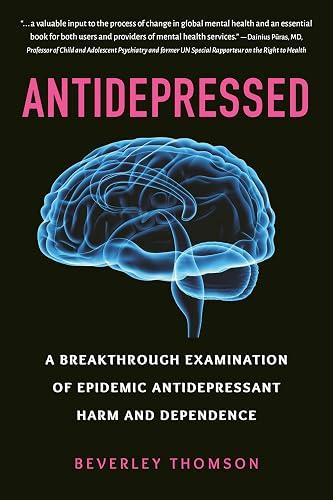
Every year, millions of people visit their doctors with complaints that have nothing to do with disease. They describe sadness that will not lift, anxiety that tightens the chest, grief that feels unbearable, exhaustion that sleep cannot fix. They describe the ordinary and extraordinary difficulties of being human. And increasingly, they leave those appointments with a diagnosis and a prescription. The diagnosis is usually depression or anxiety. The prescription is usually an antidepressant. The explanation is usually the same: your brain chemistry is out of balance, and this medication will correct it. This explanation feels satisfying. It removes blame. It offers hope. It transforms a confusing emotional struggle into a manageable medical problem with a clear solution. There is only one difficulty. The explanation is not true. Beverley Thomson's Antidepressed confronts one of the most pervasive and consequential myths in modern medicine: the idea that emotional distress is primarily a biological disease requiring chemical correction. She argues that we have collectively accepted a story about depression and antidepressants that has no scientific foundation, and that this acceptance has created a public health crisis hiding in plain sight. The scale of the issue is staggering. Antidepressants are among the most prescribed medications in the world. In many countries, more than one in ten adults takes them. Some have taken them for decades. Yet the evidence for their effectiveness is remarkably thin, and the evidence of their harms is increasingly difficult to ignore. Thomson does not argue that emotional suffering is trivial or that people should simply "snap out of it." She recognizes that depression, anxiety, and trauma are real and deeply painful experiences. Her argument is different. She argues that the medical model we have adopted for understanding and treating these experiences is fundamentally flawed, and that the drugs we use are far more powerful, far less effective, and far more dangerous than we have been led to believe. The book draws on decades of research, clinical experience, and the testimonies of countless patients who have struggled with…
Continue reading in the MinuteRead app
Get the complete 30-minute summary of Antidepressed
Get the complete summary in the appThe chemical imbalance theory of depression is unproven. No biological test can diagnose depression or demonstrate a che
Antidepressants do not correct a chemical imbalance. They create a new, drug-induced state that alters brain function in
For most people, antidepressants offer little benefit over placebo. The small statistical difference in some trials may
Antidepressant adverse effects are serious and widespread. They include sexual dysfunction, emotional numbing, weight ga
Antidepressants can increase suicidal thoughts and behaviors in some people, particularly young people. The FDA has issu
Antidepressant withdrawal can be severe and prolonged. It is frequently misdiagnosed as relapse, leading to lifelong med
"Antidepressed" is a strong fit if you want practical ideas around psychology, health, mental health, especially themes like the chemical imbalance theory of depression is unproven. no biological test can diagnose depression or demonstrate a che; antidepressants do not correct a chemical imbalance. they create a new, drug-induced state that alters brain function in. The MinuteRead summary distills these concepts into a focused read, whether you're deciding whether to buy the book or applying its lessons at work.
Motivated to help readers with "Wicked" refers to a problem that cannot be fixed, Beverley Thomson wrote “Antidepressed” to package those ideas for a fast, focused read. In “Antidepressed”, Beverley Thomson focuses on "Wicked" refers to a problem that cannot be fixed. Through “Antidepressed”, Beverley Thomson distills the core ideas on psychology into lessons readers can absorb in a single short sitting. Readers turn to this work when they want Beverley Thomson's perspective on the subject witho…
Continue Reading
Access the complete 30-minute summary and thousands more nonfiction books in the MinuteRead app.

Continue reading the complete summary in the MinuteRead app.