MinuteRead
30 min
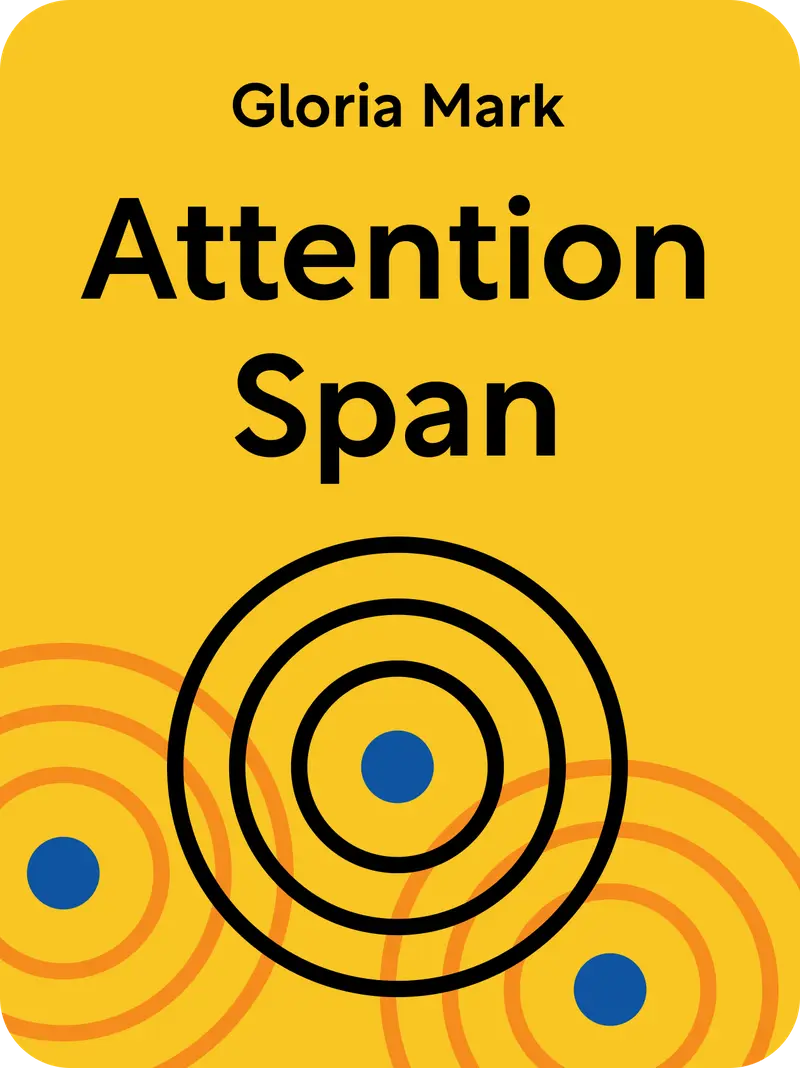
Book summary
by Gloria Mark
Premium summary · Opens in the app · 30 min read
You sit down to work. You open your laptop. You intend to write a report, analyze a spreadsheet, or simply read a document from beginning to end. Then something happens. A notification appears. You check it. You return to your task. Another notification. You check it. You remember an email you forgot to send. You send it. You return to your task. You wonder about a fact. You search for it. You follow a link. You follow another link. Forty-five minutes later, you have accomplished almost nothing.
By Gloria Mark
**Estimated Reading Time:** 45 minutes
**What You'll Learn:** Why your attention fragments every few minutes, how digital design exploits your psychology, what this costs you in stress and productivity, and how to reclaim control through awareness, agency, and deliberate practice.
**Who This Book Is For:** Anyone who has ever looked up from their phone and realized an hour disappeared. Anyone who struggles to complete deep work. Anyone who suspects their relationship with technology is not entirely healthy but cannot articulate why.
You sit down to work. You open your laptop. You intend to write a report, analyze a spreadsheet, or simply read a document from beginning to end. Then something happens. A notification appears. You check it. You return to your task. Another notification. You check it. You remember an email you forgot to send. You send it. You return to your task. You wonder about a fact. You search for it. You follow a link. You follow another link. Forty-five minutes later, you have accomplished almost nothing. This experience is not a personal failure. It is not evidence of weak willpower or a character flaw. It is the predictable result of spending your days in an environment engineered to fragment your attention. Gloria Mark has spent more than two decades studying how people interact with digital technology. As Chancellor's Professor in the Department of Informatics at the University of California, Irvine, she has conducted some of the most rigorous research ever performed on attention in the digital age. Her methods are unusual. Rather than studying people in artificial laboratory settings, she uses what she calls "living laboratories." She observes people in their actual workplaces. She tracks their computer activity second by second. She measures their heart rates. She asks them about their moods at random moments throughout the day. She has collected data on thousands of people across multiple countries and professions. What she has discovered is both sobering and liberating. The sobering part is this: our attention spans on digital devices have collapsed. In 2004, when Mark began her research, the average person spent about two and a half minutes on a single computer screen before switching to something else. By 2012, that number had dropped to seventy-five seconds. In her most recent studies, it hovers around forty-seven seconds. The trend is unmistakable. We are training ourselves, through daily practice, to be incapable of sustained focus. But the liberating part is equally important. Attention is not a fixed trait. It is a skill, a capacity that can be understood, protected, and rebuilt. The forces that fragment our attention are not mysterious. They are specific, identifiable, and often deliberately designed. Once you understand them, you can…
Continue reading in the MinuteRead app
Get the complete 30-minute summary of Attention Span
Get the complete summary in the appYour attention span on digital devices has likely shrunk to less than a minute. This is not a personal failure. It is th
Multitasking is a myth. Every task switch carries a cognitive cost that degrades performance and increases stress.
The internet's structure and algorithms are designed to capture your attention. Your attention is the product being sold
Social pressure drives much of your digital behavior. The desire for validation and the fear of missing out keep you che
Rote activities are not wasted time. They replenish your cognitive resources and improve your mood.
Meta-awareness is the foundation of attention management. You cannot control what you do not notice.
"Attention Span" is a strong fit if you want practical ideas around psychology, self help, science, especially themes like your attention span on digital devices has likely shrunk to less than a minute. this is not a personal failure. it is th; multitasking is a myth. every task switch carries a cognitive cost that degrades performance and increases stress. The MinuteRead summary distills these concepts into a focused read, whether you're deciding whether to buy the book or applying its lessons at work.
Motivated to help readers with every day, Gloria Mark wrote “Attention Span” to package those ideas for a fast, focused read. In “Attention Span”, Gloria Mark focuses on every day. Through “Attention Span”, Gloria Mark distills the core ideas on psychology into lessons readers can absorb in a single short sitting. Readers turn to this work when they want Gloria Mark's perspective on the subject without working through the entire original volume. Gloria Janet Mark is an American psychologist. Glo…
Continue Reading
Access the complete 30-minute summary and thousands more nonfiction books in the MinuteRead app.

Continue reading the complete summary in the MinuteRead app.