MinuteRead
30 min
Book summary
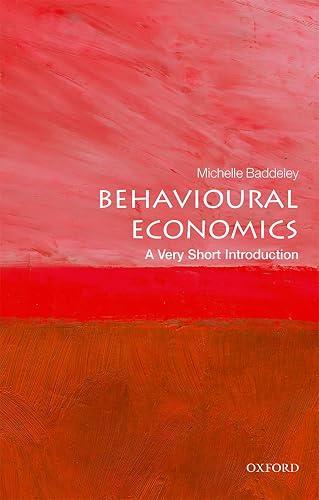
by Michelle Baddeley
Premium summary · Opens in the app · 30 min read
Economics has long presented itself as a science of rational choice. The standard model assumes that people know what they want, weigh costs and benefits carefully, and act consistently to maximize their own well-being. Given enough information, the rational actor should make optimal decisions every time.
**Author:** Michelle Baddeley **Estimated Reading Time:** 48 minutes
### What You'll Learn
Why perfectly rational economic models fail to explain how real people actually make decisions. How psychological forces like loss aversion, social pressure, and impatience shape everything from your grocery shopping to global financial crises. What nudges are, why they work, and when they cross ethical lines.
### Who This Book Is For
Anyone who has ever wondered why they made a financial decision they knew was irrational. Professionals designing policies, products, or workplaces. Students seeking a clear entry point into behavioral economics. And curious readers who want to understand the hidden forces driving human behavior in markets, governments, and everyday life.
Economics has long presented itself as a science of rational choice. The standard model assumes that people know what they want, weigh costs and benefits carefully, and act consistently to maximize their own well-being. Given enough information, the rational actor should make optimal decisions every time. There is just one problem. Real people do not behave this way. We buy gym memberships we never use. We check our phones while driving even though we know the risks. We save too little for retirement and spend too much on things we do not need. We panic during market downturns and get overconfident during booms. We make promises to ourselves about dieting, budgeting, and productivity, then break them almost immediately. Traditional economics treats these behaviors as anomalies, minor deviations from an otherwise sound model. Behavioral economics takes a different view. It argues that these so-called anomalies are not exceptions to the rule. They are the rule. Michelle Baddeley's work sits at the center of this intellectual revolution. Drawing on decades of research from psychology, neuroscience, sociology, and experimental economics, she demonstrates that human decision-making is systematically influenced by forces that traditional models ignore. Cognitive biases distort our judgment. Emotions override our calculations. Social pressures shape our choices in ways we rarely recognize. Our preferences are unstable, our willpower is limited, and our rationality is bounded. This matters far beyond academic debates. Understanding behavioral economics changes how we think about everything from personal finance to public policy. It explains why people struggle to save, why markets crash, why advertising works, why workplace incentives sometimes backfire, and why small changes in how choices are presented can have enormous effects on outcomes. The field emerged from a simple but profound observation: if we want to understand economic behavior, we need to understand human behavior. And human behavior is messy, emotional, social, and often irrational. The implications are far-reaching. For individuals, behavioral economics offers tools to recognize and overcome our own biases. For businesses, it provides insights into consumer behavior that go far…
Continue reading in the MinuteRead app
Get the complete 30-minute summary of Behavioural Economics
Get the complete summary in the appHuman rationality is bounded. We use mental shortcuts that usually work but sometimes lead to systematic errors.
Losses hurt more than equivalent gains please. This loss aversion shapes risk-taking, negotiation, and resistance to cha
People are time inconsistent. We overvalue the present and undervalue the future, leading to procrastination and under-s
Social influences are powerful. We care about fairness, follow social norms, and herd when uncertain.
Emotions shape decisions. Fear, greed, regret, and mood all influence our choices in predictable ways.
Defaults are powerful. People tend to accept whatever is presented as standard, so make the good choice the easy choice.
"Behavioural Economics" is a strong fit if you want practical ideas around economics, psychology, business, especially themes like human rationality is bounded. we use mental shortcuts that usually work but sometimes lead to systematic errors; losses hurt more than equivalent gains please. this loss aversion shapes risk-taking, negotiation, and resistance to cha. The MinuteRead summary distills these concepts into a focused read, whether you're deciding whether to buy the book or applying its lessons at work.
Motivated to help readers with behavioural economics extends economic principles by allowing that our decisions are affected by social and, Michelle Baddeley wrote “Behavioural Economics” to package those ideas for a fast, focused read. In “Behavioural Economics”, Michelle Baddeley focuses on behavioural economics extends economic principles by allowing that our decisions are affected by social and. Through “Behavioural Economics”, Michelle Baddeley distills the core ideas on economics into less…
Continue Reading
Access the complete 30-minute summary and thousands more nonfiction books in the MinuteRead app.

Continue reading the complete summary in the MinuteRead app.