MinuteRead
30 min
Book summary
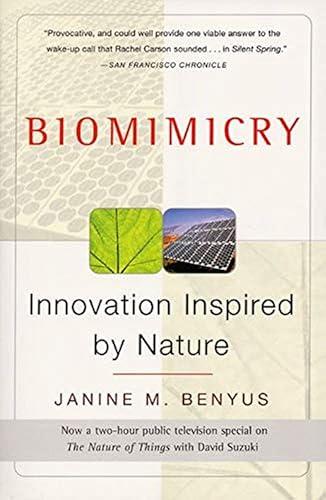
by Janine M. Benyus
Premium summary · Opens in the app · 30 min read
Imagine walking into a laboratory that has been running experiments for 3.8 billion years. In this laboratory, the research and development budget is limitless, the testing protocols are brutally rigorous, and the results speak for themselves. Every organism alive today represents a successful solution to a set of problems that would baffle our best engineers. Every leaf, every shell, every strand of silk is a patent waiting to be read.
### Innovation Inspired by Nature
**By Janine M. Benyus**
**Estimated Reading Time:** 45 minutes
**What You'll Learn:** How 3.8 billion years of natural selection have produced elegant solutions to problems humans are only beginning to solve, and how emulating nature's designs can transform agriculture, energy, materials, medicine, computing, and industry.
**Who This Book Is For:** Innovators, designers, engineers, entrepreneurs, environmentalists, and anyone curious about how the natural world can guide us toward a more sustainable and intelligent future.
Imagine walking into a laboratory that has been running experiments for 3.8 billion years. In this laboratory, the research and development budget is limitless, the testing protocols are brutally rigorous, and the results speak for themselves. Every organism alive today represents a successful solution to a set of problems that would baffle our best engineers. Every leaf, every shell, every strand of silk is a patent waiting to be read. This laboratory is the natural world, and we have only recently begun to take it seriously as a source of wisdom. For most of human history, we have treated nature as a warehouse of raw materials. We extract, we harvest, we mine, and we manufacture. Our approach to problem-solving has been characterized by what Janine Benyus calls the "heat, beat, and treat" method: apply high temperatures, apply force, and apply chemicals until the material submits. This approach has produced remarkable achievements, but it has also produced pollution, waste, and a growing sense that we are working against the grain of the planet rather than with it. The alternative is biomimicry, a new discipline that asks a deceptively simple question: How would nature solve this problem? The premise is straightforward. Organisms have been solving problems for billions of years. They have learned to capture energy from sunlight, to build structures from abundant materials, to process information without centralized control, and to create closed-loop systems where waste from one process feeds another. They have done all of this at ambient temperatures, without toxic chemicals, and in ways that enhance rather than degrade their surroundings. Consider the spider. It produces silk at room temperature from nothing more than digested insects. The result is a fiber that, ounce for ounce, is five times stronger than steel and far more elastic. Our own production of high-strength fibers requires petroleum, high temperatures, and toxic solvents. The spider's approach is not primitive; it is sophisticated beyond our current abilities. Or consider the leaf. It captures solar energy with an efficiency that rivals our best photovoltaic cells, and it does so using materials that are biodegradable and self-repairing. It produces no toxic waste. When it falls, it feeds the soil that nourishes the tree. These are not isolated examples. They…
Continue reading in the MinuteRead app
Get the complete 30-minute summary of Biomimicry
Get the complete summary in the appNature has been solving problems for 3.8 billion years, and the solutions that work are all around us.
Biomimicry means treating nature as model, measure, and mentor.
The prairie offers a model for sustainable agriculture: perennial, diverse, and self-sustaining.
Photosynthesis is a proven solar energy system that we can learn to mimic.
Natural materials like spider silk and abalone shell achieve remarkable properties through structure, not exotic ingredi
Animals self-medicate, and observing their behavior can lead to new medicines.
"Biomimicry" is a strong fit if you want practical ideas around science, nature, biology, especially themes like nature has been solving problems for 3.8 billion years, and the solutions that work are all around us; biomimicry means treating nature as model, measure, and mentor. The MinuteRead summary distills these concepts into a focused read, whether you're deciding whether to buy the book or applying its lessons at work.
Motivated to help readers with after 3.8 billion years of research and development, Janine M. Benyus wrote “Biomimicry” to package those ideas for a fast, focused read. In “Biomimicry”, Janine M. Benyus focuses on after 3.8 billion years of research and development. Through “Biomimicry”, Janine M. Benyus distills the core ideas on science into lessons readers can absorb in a single short sitting. Readers turn to this work when they want Janine M. Benyus's perspective on the subject without worki…
Continue Reading
Access the complete 30-minute summary and thousands more nonfiction books in the MinuteRead app.

Continue reading the complete summary in the MinuteRead app.