MinuteRead
30 min
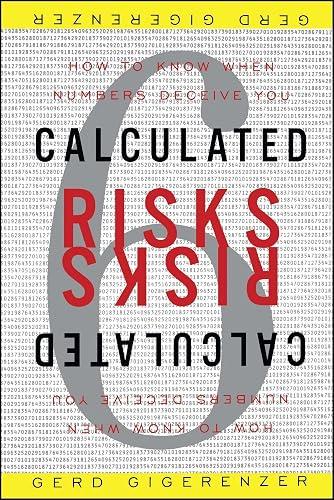
Imagine sitting in a doctor's office. The physician looks at your test results and says, "Your mammogram came back positive." Your heart races. Your mind floods with fear. You assume the worst. But what if the doctor then told you that out of every ten women with a positive mammogram, only one actually has breast cancer? Would that change how you feel? Would it change what you decide to do next?
**Author:** Gerd Gigerenzer
**Estimated Reading Time:** 48 minutes
**What You'll Learn:**
- Why certainty is an illusion in medicine, law, and everyday life - How to understand risk and probability through natural frequencies - Why medical screenings and DNA tests are less reliable than most people believe - How to recognize misleading risk communication - Practical tools for making better decisions under uncertainty
**Who This Book Is For:**
This book is for anyone who has ever received a medical test result, served on a jury, read a headline about health risks, or simply wanted to understand how to think clearly about uncertainty. It is for patients, doctors, lawyers, judges, policymakers, and every person who must make decisions without perfect information. If you have ever felt confused by statistics or intimidated by numbers, this book will transform that confusion into insight.
Imagine sitting in a doctor's office. The physician looks at your test results and says, "Your mammogram came back positive." Your heart races. Your mind floods with fear. You assume the worst. But what if the doctor then told you that out of every ten women with a positive mammogram, only one actually has breast cancer? Would that change how you feel? Would it change what you decide to do next? Most of us believe that modern technology has eliminated uncertainty from our lives. We trust DNA tests to identify criminals with absolute precision. We trust medical screenings to detect diseases with perfect accuracy. We trust fingerprint analysis to link suspects to crime scenes without error. This trust is dangerously misplaced. Gerd Gigerenzer, a psychologist and director at the Max Planck Institute for Human Development in Berlin, has spent decades studying how people make decisions under uncertainty. His research reveals a troubling pattern. The very professionals we rely on for accurate information often misunderstand the statistics they use. Doctors misinterpret test results. Lawyers confuse probabilities in court. Judges make rulings based on flawed reasoning about evidence. And ordinary people suffer the consequences. The problem is not a lack of intelligence. It is a lack of statistical literacy. Gigerenzer calls this "innumeracy," and he argues that it is one of the most dangerous and widespread forms of ignorance in modern society. Innumeracy leads to unnecessary surgeries, wrongful convictions, misguided health policies, and personal decisions based on fear rather than fact. Benjamin Franklin famously wrote, "In this world nothing is certain but death and taxes." Gigerenzer builds his entire approach on this foundation. Uncertainty is not an anomaly to be eliminated. It is the fundamental condition of human existence. The question is not how to achieve certainty, but how to make good decisions in its absence. The good news is that statistical…
Continue reading in the MinuteRead app
Get the complete 30-minute summary of Calculated Risks
Get the complete summary in the appNothing is certain. Every test and technology has error rates that must be considered.
Innumeracy is widespread, even among professionals. The problem is not intelligence but representation.
Natural frequencies are more intuitive than probabilities. Use them to understand risk.
Relative risk reductions exaggerate benefits. Always ask for absolute risk reductions.
The number needed to treat tells you how many people must be treated for one to benefit.
Medical screening has harms as well as benefits. False positives and overdiagnosis are real risks.
"Calculated Risks" is a strong fit if you want practical ideas around science, psychology, mathematics, especially themes like nothing is certain. every test and technology has error rates that must be considered; innumeracy is widespread, even among professionals. the problem is not intelligence but representation. The MinuteRead summary distills these concepts into a focused read, whether you're deciding whether to buy the book or applying its lessons at work.
Motivated to help readers with in this world nothing is certain but death and taxes, Gerd Gigerenzer wrote “Calculated Risks” to package those ideas for a fast, focused read. In “Calculated Risks”, Gerd Gigerenzer focuses on in this world nothing is certain but death and taxes. Through “Calculated Risks”, Gerd Gigerenzer distills the core ideas on science into lessons readers can absorb in a single short sitting. Readers turn to this work when they want Gerd Gigerenzer's perspective on the subje…
View all summaries by Gerd GigerenzerContinue Reading
Access the complete 30-minute summary and thousands more nonfiction books in the MinuteRead app.

Continue reading the complete summary in the MinuteRead app.