MinuteRead
30 min
Book summary
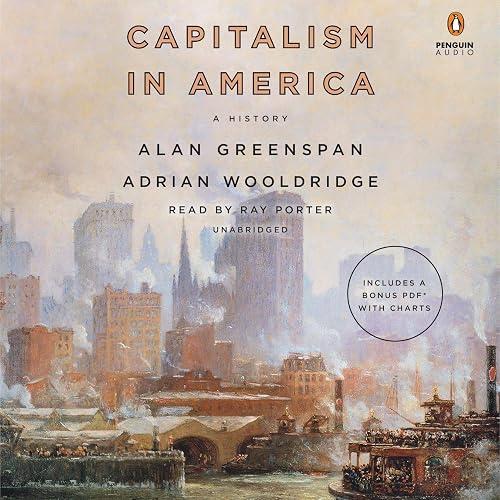
by Alan Greenspan
Premium summary · Opens in the app · 30 min read
Imagine a gathering of the world's most powerful economic minds held in 1620. Chinese scholars in silk robes discuss trade routes and imperial finances. British adventurers in woolen doublets debate colonial ventures. Ottoman administrators in turbans and caftans analyze tax revenues and military expenditures. If you had asked any of them which region of the world would dominate the global economy three centuries later, not one would have pointed to the eastern coast of North America.
**Author:** Alan Greenspan
**Estimated Reading Time:** 45 minutes
**What You'll Learn:** How the United States transformed from a colonial backwater into the world's most powerful economy, the forces that drove its rise, the crises that threatened its dominance, and what its economic history reveals about the future.
**Who This Book Is For:** Anyone who wants to understand the deep economic forces that shaped modern America, from entrepreneurs and investors to students of history and readers curious about how capitalism actually works in practice.
Imagine a gathering of the world's most powerful economic minds held in 1620. Chinese scholars in silk robes discuss trade routes and imperial finances. British adventurers in woolen doublets debate colonial ventures. Ottoman administrators in turbans and caftans analyze tax revenues and military expenditures. If you had asked any of them which region of the world would dominate the global economy three centuries later, not one would have pointed to the eastern coast of North America. At that moment, the land that would become the United States was an economic void. No significant industries. No financial markets. No manufacturing centers. A scattering of European settlements clung to the Atlantic coastline, dependent on distant empires for survival. The indigenous populations, while culturally rich, had not developed the economic institutions that would later define modern capitalism. Yet by the early twentieth century, this same territory had become the largest economy on Earth. By the end of World War II, a country with roughly seven percent of the world's population produced 42 percent of its manufactured goods, 57 percent of its steel, and 80 percent of its automobiles. The transformation was not merely remarkable. It was historically unprecedented. Alan Greenspan spent decades at the center of American economic power. As Chairman of the Federal Reserve from 1987 to 2006, he witnessed firsthand how the machinery of American capitalism operated, how it responded to shocks, and how it evolved over time. In this book, he steps back from the immediate concerns of monetary policy to examine the long arc of American economic history. The central question is simple: How did this happen? How did a collection of colonies on the edge of the known world become the engine of global capitalism? And what does that history tell us about where America is headed now? The answer, Greenspan argues, lies in a unique combination of factors. America possessed vast natural resources and abundant land. It developed political institutions that protected property rights and encouraged entrepreneurship. It welcomed immigrants who brought energy, ambition, and skills. It embraced technological innovation with an enthusiasm unmatched elsewhere. And it cultivated a culture that celebrated risk-taking and rewarded success. But the story is not one of uninterrupted…
Continue reading in the MinuteRead app
Get the complete 30-minute summary of Capitalism in America
Get the complete summary in the appCreative destruction is the engine of American economic growth. New technologies and business models continually replace
Institutions matter. Property rights, contract enforcement, and the rule of law are the foundation of economic activity.
The American economy has repeatedly reinvented itself through painful but ultimately beneficial transitions.
The Civil War determined that American capitalism would be based on free labor.
The Great Depression led to the creation of the modern welfare state and a fundamental rethinking of government's role.
The post-war Golden Age was built on a combination of market forces and government policies.
"Capitalism in America" is a strong fit if you want practical ideas around economics, history, business, especially themes like creative destruction is the engine of american economic growth. new technologies and business models continually replace; institutions matter. property rights, contract enforcement, and the rule of law are the foundation of economic activity. The MinuteRead summary distills these concepts into a focused read, whether you're deciding whether to buy the book or applying its lessons at work.
Motivated to help readers with "Imagine that a version of the World Economic Forum was held in Davos in 1620, Alan Greenspan wrote “Capitalism in America” to package those ideas for a fast, focused read. In “Capitalism in America”, Alan Greenspan focuses on "Imagine that a version of the World Economic Forum was held in Davos in 1620. Through “Capitalism in America”, Alan Greenspan distills the core ideas on economics into lessons readers can absorb in a single short sitting. Readers turn to thi…
Continue Reading
Access the complete 30-minute summary and thousands more nonfiction books in the MinuteRead app.

Continue reading the complete summary in the MinuteRead app.