MinuteRead
30 min
Book summary
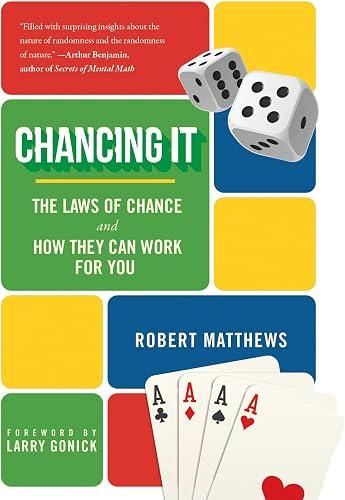
by Robert Matthews
Premium summary · Opens in the app · 30 min read
Every day you make decisions under conditions of uncertainty. You decide whether to carry an umbrella based on a weather forecast. You choose whether to take a new job, start a business, or trust a medical screening result. You weigh risks and rewards, often without realizing that you are doing probability calculations in your head.
**Author:** Robert Matthews
**Estimated Reading Time:** 45 minutes
**What You'll Learn:**
* Why probability is the most practical branch of mathematics you will ever encounter * How to calculate whether any decision is worth taking before you commit * Why the Law of Averages is routinely misunderstood and how to use it correctly * How Bayes' Theorem can sharpen your thinking about everything from medical tests to everyday judgments * Why extreme events follow their own mathematical rules and what that means for your life * How to spot the hidden traps in data, correlations, and financial models
**Who This Book Is For:**
Anyone who has ever wondered whether an insurance policy is worth the premium, whether a medical test result is truly alarming, or whether a "sure thing" investment is actually sure. This book is for people who want to make better decisions under uncertainty without needing a degree in statistics.
Every day you make decisions under conditions of uncertainty. You decide whether to carry an umbrella based on a weather forecast. You choose whether to take a new job, start a business, or trust a medical screening result. You weigh risks and rewards, often without realizing that you are doing probability calculations in your head. Most people do these calculations badly. Not because they are unintelligent, but because nobody ever taught them how to think clearly about chance. School mathematics tends to treat probability as an abstract exercise involving dice and playing cards. The real world is messier. The stakes are higher. And the consequences of getting it wrong can be severe. Robert Matthews wrote *Chancing It* to bridge this gap. The book argues that probability is not a niche academic subject. It is a practical toolkit for navigating life. Matthews, a physicist and award-winning science writer, has spent decades explaining complex ideas to general audiences. His central conviction is simple: the mathematics of uncertainty can be understood by anyone willing to engage with it, and the payoff for doing so is enormous. The problem the book addresses is not that people ignore probability. It is that they use it poorly. They rely on gut feelings when a simple calculation would serve them better. They misinterpret data. They draw false conclusions from correlations. They underestimate the likelihood of rare but catastrophic events. They trust financial models that are built on shaky assumptions. Matthews traces these failures to a common root: humans are not naturally equipped to reason about chance. Our brains evolved to spot patterns and make quick judgments, not to calculate expected values or update beliefs with statistical precision. This served our ancestors well on the savanna. It serves us less well in a world of complex…
Continue reading in the MinuteRead app
Get the complete 30-minute summary of Chancing It
Get the complete summary in the app**Expected value is the key to rational decisions.** Multiply each outcome by its probability and sum the results. Take
**The Law of Averages is about proportions, not raw numbers.** Over many trials, relative frequencies converge on the un
**Past outcomes do not influence future probabilities.** The gambler's fallacy is a fallacy.
**Bayes' Theorem updates beliefs with evidence.** Your new belief equals your old belief plus the weight of new evidence
**The base rate matters.** A positive test result is not the same as having the disease.
**Correlation does not imply causation.** Look for mechanisms, hidden variables, and reverse causality.
"Chancing It" is a strong fit if you want practical ideas around science, mathematics, psychology, especially themes like **expected value is the key to rational decisions.** multiply each outcome by its probability and sum the results. take; **the law of averages is about proportions, not raw numbers.** over many trials, relative frequencies converge on the un. The MinuteRead summary distills these concepts into a focused read, whether you're deciding whether to buy the book or applying its lessons at work.
Motivated to help readers with pascal's rule simply applies the same reasoning down to each individual bet, Robert Matthews wrote “Chancing It” to package those ideas for a fast, focused read. In “Chancing It”, Robert Matthews focuses on pascal's rule simply applies the same reasoning down to each individual bet. Through “Chancing It”, Robert Matthews distills the core ideas on science into lessons readers can absorb in a single short sitting. Readers turn to this work when they want Robert Matt…
Continue Reading
Access the complete 30-minute summary and thousands more nonfiction books in the MinuteRead app.

Continue reading the complete summary in the MinuteRead app.