MinuteRead
30 min
Book summary
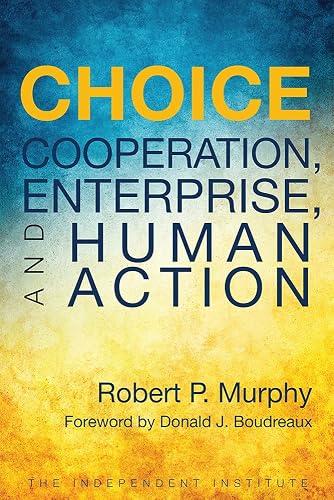
by Robert P. Murphy
Premium summary · Opens in the app · 30 min read
Every day you make thousands of choices. Some are trivial: what to eat for breakfast, which route to take to work, whether to check your phone now or in five minutes. Others carry more weight: whether to accept a job offer, how much to save for retirement, whether to start a business. You make these choices without much thought, trusting your instincts and your understanding of the world around you.
**Author:** Robert P. Murphy **Estimated Reading Time:** 42 minutes
The hidden logic that governs every decision you make, why some societies prosper while others collapse, and how a single insight about human nature explains everything from interest rates to the failure of socialism.
Anyone who has ever wondered why economies boom and bust, why government programs so often backfire, or what truly drives human behavior in the marketplace. This book is for readers who want to understand economics not as a collection of statistics and policy debates, but as a rigorous science of human choice.
Every day you make thousands of choices. Some are trivial: what to eat for breakfast, which route to take to work, whether to check your phone now or in five minutes. Others carry more weight: whether to accept a job offer, how much to save for retirement, whether to start a business. You make these choices without much thought, trusting your instincts and your understanding of the world around you. But beneath these everyday decisions lies a profound truth that most people never recognize. Every choice you make reveals something fundamental about human nature. And when millions of people make choices simultaneously, those choices create patterns that shape entire civilizations. This book is about understanding those patterns. The ideas presented here are not new. They were developed over decades by economists who belonged to a tradition known as the Austrian School. The most important figure in this tradition was Ludwig von Mises, whose 1949 treatise *Human Action* laid out a complete framework for understanding economics as a science of human choice. That book runs nearly a thousand pages and is notoriously dense, filled with technical language and philosophical arguments that can intimidate even dedicated readers. Robert P. Murphy wrote *Choice* to solve that problem. He recognized that Mises's insights were too important to remain locked away in academic obscurity. The core ideas of Austrian economics have the power to transform how you understand the world, but only if they are presented clearly and accessibly. The central insight is deceptively simple: human beings act purposefully. We do things for reasons. We choose means to achieve ends. This observation, which seems almost too obvious to mention, turns out to have enormous implications. From this single starting point, an entire science unfolds. If humans act purposefully, then they must value some things more than others. If they value things differently, then exchange becomes possible. If exchange becomes possible, then prices emerge. If prices emerge, then economic calculation becomes possible. And if economic calculation becomes possible, then entire economies can be coordinated without anyone being in charge. But the implications run deeper still. If humans act purposefully, then they…
Continue reading in the MinuteRead app
Get the complete 30-minute summary of Choice
Get the complete summary in the appHuman action is purposeful behavior aimed at achieving subjective ends.
Value is subjective and exists only in the minds of individuals.
Voluntary exchange is always mutually beneficial.
Time preference is the universal preference for present goods over future goods.
Interest is the price of time and arises from time preference.
Money emerged spontaneously to overcome the double coincidence of wants.
"Choice" is a strong fit if you want practical ideas around economics, capitalism, money, especially themes like human action is purposeful behavior aimed at achieving subjective ends; value is subjective and exists only in the minds of individuals. The MinuteRead summary distills these concepts into a focused read, whether you're deciding whether to buy the book or applying its lessons at work.
Motivated to help readers with "Time preference is a categorial requisite of human action, Robert P. Murphy wrote “Choice” to package those ideas for a fast, focused read. In “Choice”, Robert P. Murphy focuses on "Time preference is a categorial requisite of human action. Through “Choice”, Robert P. Murphy distills the core ideas on economics into lessons readers can absorb in a single short sitting. Readers turn to this work when they want Robert P. Murphy's perspective on the subject without w…
Continue Reading
Access the complete 30-minute summary and thousands more nonfiction books in the MinuteRead app.

Continue reading the complete summary in the MinuteRead app.