MinuteRead
30 min
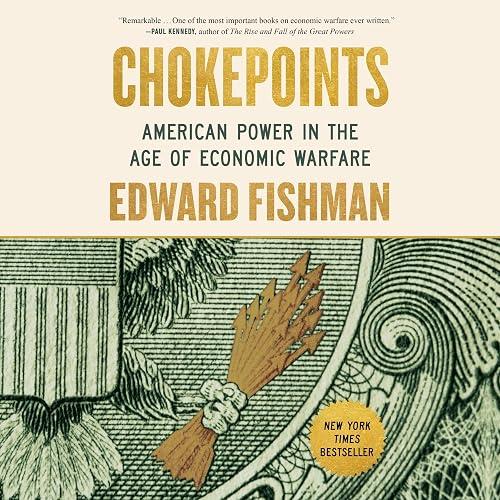
Book summary
by Edward Fishman
Premium summary · Opens in the app · 30 min read
In February 2022, Russian tanks rolled across the Ukrainian border. Within days, the United States and its allies responded not with soldiers or missiles, but with a weapon few people fully understood. They froze the assets of Russia's central bank. They cut major Russian banks off from the global financial system. They banned the export of advanced semiconductors to Russian companies.
**Author:** Edward Fishman
**Estimated Reading Time:** 45 minutes
**What You'll Learn:** How economic warfare became America's primary tool of global influence, why the dollar and technology supply chains function as modern weapons, and what this means for the future of globalization, geopolitics, and your own understanding of international power.
**Who This Book Is For:** Anyone seeking to understand how nations actually compete in the twenty-first century. Whether you work in business, policy, technology, or simply want to grasp the hidden forces shaping world events, this book reveals the invisible infrastructure of power that determines outcomes in conflicts from Ukraine to the South China Sea.
In February 2022, Russian tanks rolled across the Ukrainian border. Within days, the United States and its allies responded not with soldiers or missiles, but with a weapon few people fully understood. They froze the assets of Russia's central bank. They cut major Russian banks off from the global financial system. They banned the export of advanced semiconductors to Russian companies. None of these actions required a single American soldier to fire a shot. Yet within weeks, the ruble collapsed, Russian businesses found themselves unable to process international payments, and the country's military-industrial complex began struggling to source the components needed for precision weapons. This is economic warfare. It is how America fights its most important geopolitical battles today. The story of how this came to be is one of the most consequential and least understood developments in modern international relations. For most of history, economic sanctions were viewed as weak instruments, symbolic gestures that made politicians feel good but rarely changed the behavior of adversaries. They required broad international consensus, formidable naval power to enforce, and years of patience to produce results. More often than not, they failed. Then everything changed. The transformation began quietly, in the aftermath of the September 11 attacks, when a small team of lawyers and analysts at the U.S. Treasury Department began asking a simple question: What if we could use the architecture of the global financial system itself as a weapon? The answer to that question would reshape the world. It would bring Iran to the negotiating table. It would send shockwaves through the Russian economy. It would spark a technological arms race with China. And it would ultimately force every nation on earth to confront an uncomfortable truth: the same economic interdependence that had brought unprecedented prosperity had also created unprecedented vulnerability. Edward Fishman witnessed this transformation from the inside. As a senior official at the Treasury Department, the State Department, and the Pentagon, he helped design and implement some of the most consequential economic warfare campaigns in American history. He sat in the rooms where decisions were…
Continue reading in the MinuteRead app
Get the complete 30-minute summary of Chokepoints
Get the complete summary in the appEconomic warfare is how America fights its most important geopolitical battles today, using the infrastructure of global
The U.S. dollar is the ultimate chokepoint, giving the United States jurisdiction over nearly all international financia
The Iran campaign proved that financial warfare could work, bringing Iran to the negotiating table through economic pres
The Russia 2014 campaign showed that caution has costs, as incremental sanctions allowed Russia time to adapt.
The technology struggle with China is fundamentally about power, not trade. American technological leadership underpins
The Foreign Direct Product Rule extends U.S. export controls to foreign companies, giving the United States leverage ove
"Chokepoints" is a strong fit if you want practical ideas around economics, politics, globalization, especially themes like economic warfare is how america fights its most important geopolitical battles today, using the infrastructure of global; the u.s. dollar is the ultimate chokepoint, giving the united states jurisdiction over nearly all international financia. The MinuteRead summary distills these concepts into a focused read, whether you're deciding whether to buy the book or applying its lessons at work.
Motivated to help readers with 1) Economic Warfare: The New Global Battlefield 2) The Dollar's Unseen Power: America's Ultimate Chokepoint, Edward Fishman wrote “Chokepoints” to package those ideas for a fast, focused read. In “Chokepoints”, Edward Fishman focuses on 1) Economic Warfare: The New Global Battlefield 2) The Dollar's Unseen Power: America's Ultimate Chokepoint. Through “Chokepoints”, Edward Fishman distills the core ideas on economics into lessons readers can absorb in a single shor…
Continue Reading
Access the complete 30-minute summary and thousands more nonfiction books in the MinuteRead app.

Continue reading the complete summary in the MinuteRead app.