MinuteRead
30 min
Book summary
by Emily Balcetis
Premium summary · Opens in the app · 30 min read
Every year, millions of people set goals. They want to lose weight, save money, run a marathon, learn a language, or build a business. And every year, most of them fail. Not because they lack willpower. Not because they do not care enough. But because they are looking at the problem in the wrong way. Literally.
**Author:** Emily Balcetis **Estimated Reading Time:** 42 minutes
**What You'll Learn:** How the way you see the world shapes what you achieve. You will discover four visual strategies that elite performers use to stay motivated, make better decisions, and reach their goals with less struggle.
**Who This Book Is For:** Anyone who has ever set a goal and struggled to follow through. If you want to understand why some people seem to see opportunities where others see obstacles, this book will change how you look at everything.
Every year, millions of people set goals. They want to lose weight, save money, run a marathon, learn a language, or build a business. And every year, most of them fail. Not because they lack willpower. Not because they do not care enough. But because they are looking at the problem in the wrong way. Literally. Emily Balcetis is a psychologist at New York University who studies vision science. Her work sits at the intersection of what we see and what we do. For years, she has investigated a simple but profound question: does the way we look at the world change what we are capable of achieving? Her answer, backed by rigorous research and compelling stories from the worlds of sports, business, and everyday life, is an emphatic yes. The central problem Balcetis addresses is the gap between intention and action. We know what we should do. We want to do it. Yet we do not do it. Traditional advice tells us to try harder, to build better habits, to find more motivation. But Balcetis discovered something different. The most successful people do not just try harder. They see differently. Consider a simple experiment. Balcetis asked people to estimate the distance to a finish line. Those who were physically fit saw the line as closer than those who were out of shape. The same physical distance appeared shorter to people whose bodies were prepared for the challenge. This was not a trick of the eyes. It was a trick of the brain. Our perception of the world is shaped by our ability to engage with it. Now consider the reverse. If our physical state changes how we see distances, can we change how we see distances to change our physical performance? Balcetis found that the answer is yes. When she taught people to use specific visual strategies, their performance improved dramatically. They ran faster, felt less tired, and reported that the same distance seemed shorter. This is the core insight of the book. Perception is not a passive recording of reality. It is an active construction. And because it is active, it can be controlled. You can learn to see the world…
Continue reading in the MinuteRead app
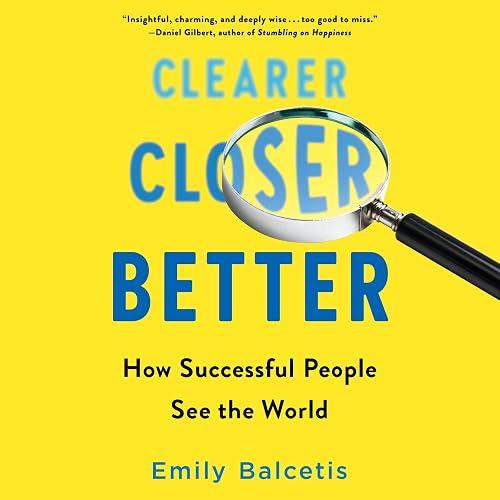
Get the complete 30-minute summary of Clearer, Closer, Better
Get the complete summary in the app**See less to achieve more.** Narrow your focus to make goals feel closer.
**Make it real.** Materialize your goals with writing, pictures, and concrete plans.
**Choose your frame.** How you interpret a situation determines how you feel and perform.
**Zoom out to see patterns.** Wide bracketing reveals the cumulative impact of small choices.
**Stop multitasking.** Focus on one thing at a time to improve quality and speed.
**Practice until it is automatic.** Expertise frees mental energy for higher-level thinking.
"Clearer, Closer, Better" is a strong fit if you want practical ideas around psychology, self help, business, especially themes like **see less to achieve more.** narrow your focus to make goals feel closer; **make it real.** materialize your goals with writing, pictures, and concrete plans. The MinuteRead summary distills these concepts into a focused read, whether you're deciding whether to buy the book or applying its lessons at work.
Motivated to help readers with "White, Emily Balcetis wrote “Clearer, Closer, Better” to package those ideas for a fast, focused read. In “Clearer, Closer, Better”, Emily Balcetis focuses on "White. Through “Clearer, Closer, Better”, Emily Balcetis distills the core ideas on psychology into lessons readers can absorb in a single short sitting. Readers turn to this work when they want Emily Balcetis's perspective on the subject without working through the entire original volume. Emily Balcetis wr…
Continue Reading
Access the complete 30-minute summary and thousands more nonfiction books in the MinuteRead app.

Continue reading the complete summary in the MinuteRead app.