MinuteRead
30 min
Book summary
by Andrew Brooks
Premium summary · Opens in the app · 30 min read
Every morning, billions of people reach into wardrobes and pull out garments without a second thought. A shirt made in Bangladesh. Jeans assembled in China. A dress stitched in Vietnam. The labels tell us where our clothes were made, but they reveal almost nothing about how they got there, who made them, and what happens when we no longer want them.
**Author:** Andrew Brooks **Estimated Reading Time:** 42 minutes
The hidden journey of your clothes from cotton field to wardrobe, and what happens after you donate them. You will discover how the global clothing trade creates and reinforces inequality between nations, why fast fashion depends on exploitation, and how second-hand clothing exports reshape economies in the developing world.
Anyone who wears clothes and wonders where they come from. Anyone who has donated to a charity shop and assumed their old shirts were helping someone in need. Anyone curious about globalization, economic development, labor rights, or the true cost of a cheap t-shirt.
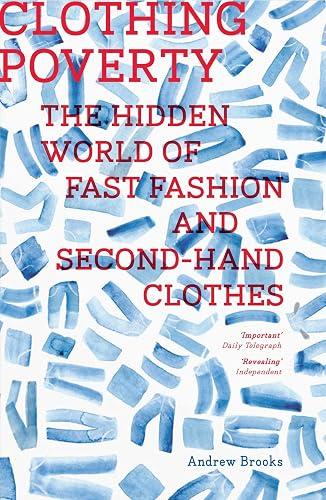
Every morning, billions of people reach into wardrobes and pull out garments without a second thought. A shirt made in Bangladesh. Jeans assembled in China. A dress stitched in Vietnam. The labels tell us where our clothes were made, but they reveal almost nothing about how they got there, who made them, and what happens when we no longer want them. Andrew Brooks wrote Clothing Poverty to answer a question that most of us never think to ask: why do poor countries make clothes for rich countries, and why do rich countries send their old clothes back? The answer is not comforting. The global clothing industry is one of the most visible expressions of a world divided by wealth and power. On one side, consumers in London, New York, and Sydney enjoy an endless parade of cheap fashion. On the other, workers in Dhaka, Guangzhou, and Ho Chi Minh City labor long hours for wages that barely sustain life. Between them stretches a vast network of cotton farms, textile mills, shipping containers, retail chains, and charity collection bins that binds the world together in a system of profound inequality. This book is not a shopping guide. It is not a list of ethical brands to buy or a set of tips for building a sustainable wardrobe. Brooks has written something more ambitious and more uncomfortable. He wants readers to understand the structure of the global clothing economy, to see how it works, and to recognize that individual choices, however well-intentioned, cannot fix a system designed to extract value from the poor and deliver it to the rich. The problem is not simply that some companies behave badly. The problem is that the entire industry operates according to a logic that requires inequality. Cheap clothes for Western consumers depend on cheap labor in poor countries. The profits that flow to fashion brands depend on keeping wages low and production costs minimal. Even the charitable act of donating used clothing feeds a trade that undermines local industries in Africa and elsewhere. Brooks approaches this subject as a geographer and development scholar.…
Continue reading in the MinuteRead app
Get the complete 30-minute summary of Clothing Poverty
Get the complete summary in the appSpatial inequality is built into the global economy. Wealth concentrates in some places while poverty persists in others
The clothing industry is a perfect example of this inequality. Poor countries produce, rich countries profit.
The global clothing trade was built through colonialism and coercion, not free markets.
Fast fashion has made clothing disposable, driving overconsumption and waste.
Most donated clothes are sold to exporters and end up in markets in developing countries.
The second-hand clothing trade provides affordable clothes but undermines local industries.
"Clothing Poverty" is a strong fit if you want practical ideas around fashion, economics, sociology, especially themes like spatial inequality is built into the global economy. wealth concentrates in some places while poverty persists in others; the clothing industry is a perfect example of this inequality. poor countries produce, rich countries profit. The MinuteRead summary distills these concepts into a focused read, whether you're deciding whether to buy the book or applying its lessons at work.
Motivated to help readers with spatial inequality is a fundamental principle of economic globalization, Andrew Brooks wrote “Clothing Poverty” to package those ideas for a fast, focused read. In “Clothing Poverty”, Andrew Brooks focuses on spatial inequality is a fundamental principle of economic globalization. Through “Clothing Poverty”, Andrew Brooks distills the core ideas on fashion into lessons readers can absorb in a single short sitting. Readers turn to this work when they want Andrew Bro…
Continue Reading
Access the complete 30-minute summary and thousands more nonfiction books in the MinuteRead app.

Continue reading the complete summary in the MinuteRead app.