MinuteRead
30 min
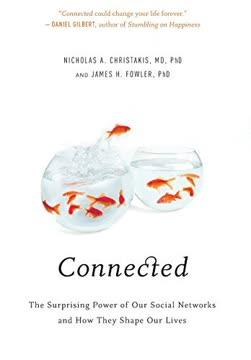
You are not an island. You are not even a peninsula. You are more like a single neuron in a vast, humming brain, connected to billions of other neurons through an intricate web of relationships that extends far beyond what you can see.
**Author:** Nicholas A. Christakis and James H. Fowler
**Estimated Reading Time:** 45 minutes
**What You'll Learn:** How the hidden architecture of social networks shapes your emotions, health, wealth, political views, and romantic life. You'll discover why your friends' friends' friends affect you more than you realize, how happiness and obesity spread like contagions, and why understanding networks is essential for navigating modern life.
**Who This Book Is For:** Anyone who has ever wondered why they suddenly feel happy around certain people, why habits seem to spread through friend groups, or how to build a life that benefits from the invisible currents of human connection.
You are not an island. You are not even a peninsula. You are more like a single neuron in a vast, humming brain, connected to billions of other neurons through an intricate web of relationships that extends far beyond what you can see. Most of us understand that our friends and family influence us. We know that the people we spend time with shape our moods, our habits, and our choices. But what we rarely recognize is that the influence doesn't stop there. It ripples outward, passing through our friends to their friends, and then to their friends' friends. By the time the wave reaches the third degree of separation, it has touched people you have never met and will never meet. This is the central insight of Nicholas Christakis and James Fowler's groundbreaking work. Over years of research using massive datasets, including the famous Framingham Heart Study, they discovered something remarkable about human social life. Our connections to others are not random. They form patterns. Those patterns have rules. And those rules shape nearly everything about us. Consider a simple fact: if your friend becomes obese, your chances of becoming obese increase by 45 percent. That's not surprising. But here's the strange part: if your friend's friend becomes obese, your chances increase by 20 percent. And if your friend's friend's friend becomes obese, your chances still increase by 10 percent. You are being influenced by people you have never met. The same pattern holds for happiness, smoking, drinking, loneliness, and even political views. Your emotional state, your health behaviors, and your beliefs are all partially determined by people who exist at the edges of your social universe. This discovery challenges our most basic assumptions about individuality. We like to think of ourselves as autonomous agents, making free choices based on our own preferences and values. But the evidence suggests something more complex. We are embedded in social networks that shape us in ways we barely understand. The problem is that most of us are network illiterate. We don't see the connections that bind us. We…
Continue reading in the MinuteRead app
Get the complete 30-minute summary of Connected
Get the complete summary in the appYour connections shape nearly every aspect of your life, from your health to your happiness to your wealth.
Influence extends up to three degrees of separation: your friends, your friends' friends, and your friends' friends' fri
Emotions are contagious. Happiness, loneliness, anxiety, and depression all spread through networks.
Health behaviors spread through networks. Obesity, smoking, and exercise habits are all influenced by your social connec
Your network position matters more than your individual traits for many outcomes.
Weak ties are crucial for accessing new information and opportunities.
"Connected" is a strong fit if you want practical ideas around psychology, sociology, science, especially themes like your connections shape nearly every aspect of your life, from your health to your happiness to your wealth; influence extends up to three degrees of separation: your friends, your friends' friends, and your friends' friends' fri. The MinuteRead summary distills these concepts into a focused read, whether you're deciding whether to buy the book or applying its lessons at work.
Nicholas A. Christakis, MD, PhD, MPH is a renowned social scientist and professor at Yale University. His research focuses on how social networks impact human behavior and health. Christakis has held positions at Harvard and the University of Chicago, and was named one of Time's 100 most influential people in 2009. He leads the Human Nature Lab, exploring topics like friendship evolution, public health interventions in developing countries, and artificial intelligence for collective action. Chri…
View all summaries by Nicholas A. ChristakisContinue Reading
Access the complete 30-minute summary and thousands more nonfiction books in the MinuteRead app.

Continue reading the complete summary in the MinuteRead app.