MinuteRead
30 min
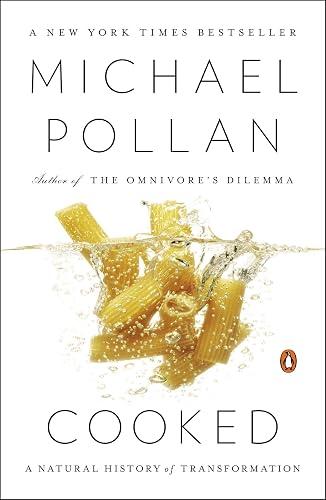
Cooked is a historical exploration of the four primary elements we use to transform our food, from fire to water, air, and earth, celebrating traditional cooking methods while showing you practical ways to improve your eating habits and prepare more of your own food.
Cooked is a historical exploration of the four primary elements we use to transform our food, from fire to water, air, and earth, celebrating traditional cooking methods while showing you practical ways to improve your eating habits and prepare more of your own food.
For the longest time, cooking has made human lives better. It enabled us to eat and digest a wider range of foods. This too also helped us preserve them to be consumed at a later date. It also provided an occasion for social bonding and enjoying meals together.
In the modern world, however, cooking seems to have become redundant. As the processed foods industry exploded after World War II, people in Western societies have been bombarded by instant meals and fast-food choices. It was supposed to make our lives more convenient and save us time spent cooking.
But what good does it do to save a bit of time, when most instant foods provide close to zero nutritional value?
This is the case because food providers often “fill up” their products with loads of sugar, salt and fat – first, to lower their costs, and second, to make them taste better. The food industry is business like any other and the point is to make money. However, the profits often come at the cost of public health.
Pollan cites a Harvard study, according to which the more time people spend cooking their own food, the better their health. Conversely, consuming lots of processed food and hence neglecting to cook their own food was correlated with overall poorer health – obesity in particular.
It seems like the simplest way to ensure a healthy diet is preparing your own meals as often as possible.
Bread is one of the most important staple foods in a lot of cultures around the world. And there are good reasons it ranks so high in so many people’s diets. In paleolith, our ancestors already consumed a variety of grains coming from wild grasses. These were the only parts of the plant that were digestible by the human body. But with time, early agricultural societies found that when seeds were soaked, mashed or roasted, they appeared to make for a more satisfying meal. The true breakthrough, however, occurred in Egypt around 4000 BC, when a bowl of mashed seeds was once left in a warm place and started to ferment. Some smart chef – the inventor of the bread! – decided to put such dough in an oven to see what happens. That’s how the first loaf in history was baked. Soon enough, bread became a widely eaten staple. That’s because it was immediately apparent that grains processed in such a way provided…
Continue reading in the MinuteRead app
Get the complete 5-minute summary of Cooked
Get the complete summary in the appThe amount of time spent in the kitchen is inversely correlated with health issues.
Baking bread “unlocks” nutrients that would be otherwise indigestible by the human body.
Alcohol is an indulgence well-known to the animal kingdom.
"Cooked" is a strong fit if you want practical ideas around culture, economics, environment, especially themes like the amount of time spent in the kitchen is inversely correlated with health issues; baking bread “unlocks” nutrients that would be otherwise indigestible by the human body. The MinuteRead summary distills these concepts into a focused read, whether you're deciding whether to buy the book or applying its lessons at work.
Michael Pollan is the author of seven previous books, including Cooked, Food Rules, In Defense of Food, The Omnivore's Dilemma and The Botany of Desire, all of which were New York Times bestsellers. A longtime contributor to the New York Times Magazine, he also teaches writing at Harvard and the University of California, Berkeley. In 2010, TIME magazine named him one of the one hundred most influential people in the world.
View all summaries by Michael PollanContinue Reading
Access the complete 5-minute summary and thousands more nonfiction books in the MinuteRead app.

Continue reading the complete summary in the MinuteRead app.