MinuteRead
30 min
Book summary
Premium summary · Opens in the app · 30 min read
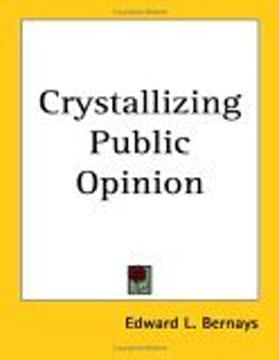
In 1923, a young man named Edward Bernays published a book that would define a profession he had essentially invented. The book was called *Crystallizing Public Opinion*, and its central claim was both simple and revolutionary: public opinion is not something that simply happens. It is something that can be understood, shaped, and directed by those who possess the right knowledge and skills.
**Author:** Edward L. Bernays **Estimated Reading Time:** 48 minutes **What You'll Learn:** How public opinion is formed, shaped, and directed through the systematic application of psychology, media strategy, and group dynamics. **Who This Book Is For:** Communicators, marketers, leaders, and anyone who wants to understand the invisible forces that shape what the public believes and why.
In 1923, a young man named Edward Bernays published a book that would define a profession he had essentially invented. The book was called *Crystallizing Public Opinion*, and its central claim was both simple and revolutionary: public opinion is not something that simply happens. It is something that can be understood, shaped, and directed by those who possess the right knowledge and skills. Bernays had spent the previous decade working in the emerging field of publicity and propaganda. He had promoted Broadway shows, organized campaigns for the US government during the First World War, and advised corporations on how to manage their public image. Through this work, he came to a profound realization. The public does not form opinions through careful, rational deliberation. It forms opinions through emotion, association, and the influence of trusted figures. And if you understand how these forces work, you can help shape the public mind. The book arrived at a moment of extraordinary transformation. Mass media was expanding rapidly. Newspapers, magazines, radio, and film were creating new pathways for information to reach millions of people simultaneously. For the first time in history, it was possible to communicate with an entire nation at once. This created enormous opportunities for those who understood how to use these channels effectively. It also created enormous risks. The same tools that could inform the public could also mislead it. Bernays recognized that a new kind of professional was needed. Someone who could serve as a bridge between organizations and the public. Someone who understood both the psychology of the crowd and the mechanics of mass communication. He called this professional the "public relations counsel." The problem Bernays identified was that most organizations had no systematic way of understanding or influencing public opinion. They operated on guesswork and intuition. They assumed that if they simply told the truth, the public would respond rationally. But Bernays knew this was naive. The public does not respond to facts alone. It responds to how those facts are framed, who presents them, and what emotional associations they trigger. This is why the book remains startlingly relevant. We live in an age of information overload, where attention is scarce and opinion is shaped by algorithms, influencers, and carefully crafted narratives. The fundamental dynamics Bernays described have not changed. They have only intensified. Understanding how public opinion is crystallized is not…
Continue reading in the MinuteRead app
Get the complete 30-minute summary of Crystallizing Public Opinion
Get the complete summary in the appPublic opinion can be understood and shaped through systematic effort.
People are driven by emotion and instinct more than by reason.
Groups and social norms shape individual behavior.
Stereotypes and symbols are powerful tools of persuasion.
The media is a system with its own rules that must be understood.
Creating news is more effective than buying attention.
"Crystallizing Public Opinion" is a strong fit if you want practical ideas around psychology, politics, sociology, especially themes like public opinion can be understood and shaped through systematic effort; people are driven by emotion and instinct more than by reason. The MinuteRead summary distills these concepts into a focused read, whether you're deciding whether to buy the book or applying its lessons at work.
Edward L. Bernays was an Austrian-American pioneer in public relations and propaganda, dubbed "the father of public relations." Born in 1891, he was the nephew of Sigmund Freud and applied psychological principles to shape public opinion. Edward Louis Bernays worked on influential campaigns, including promoting female smoking and assisting in the CIA-backed overthrow of Guatemala's government. His work significantly impacted advertising, marketing, and political communication. Bernays authored s…
View all summaries by Edward L. BernaysContinue Reading
Access the complete 30-minute summary and thousands more nonfiction books in the MinuteRead app.

Continue reading the complete summary in the MinuteRead app.