MinuteRead

30 min
Book summary
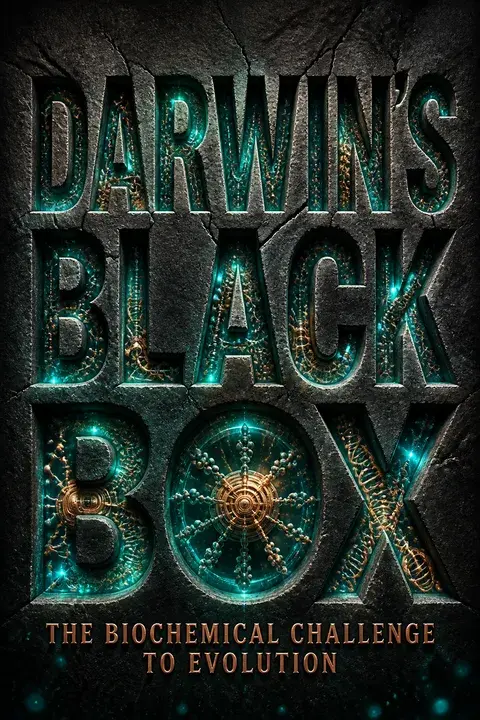
by Michael J. Behe
Premium summary · Opens in the app · 30 min read
In 1859, Charles Darwin published a book that changed how we think about life. On the Origin of Species made a simple but radical claim: the diversity of living things could be explained by natural processes operating over vast stretches of time. Small variations arise in populations. Some variations help organisms survive and reproduce. Over countless generations, these advantageous traits accumulate, and new forms of life emerge.
**Michael J. Behe**
**Estimated Reading Time: 55 to 65 minutes**
For a century and a half, the debate over evolution has been conducted at the level of bones, shells, and fins. Michael Behe argues that this is the wrong place to look. The real action, he says, happens at a scale Darwin could never have imagined: the molecular machinery inside every living cell.
This condensed edition walks through Behe's central argument. You will learn why he believes that certain biochemical systems could not have arisen through gradual, step-by-step processes. You will encounter the bacterial flagellum, the blood clotting cascade, the immune system, and the intricate transport networks inside cells. You will understand what Behe means by irreducible complexity and why he thinks it poses a serious challenge to standard evolutionary theory.
You will also see the limits of his argument, the objections it faces, and the questions it leaves open. This is not a book that settles a debate. It is a book that reframes one.
This book is for anyone who has wondered whether the standard story of evolution is complete. It is for readers curious about what actually happens inside a cell and why the molecular world looks so different from the world of fossils and finches. It is for students of biology who want to understand a controversial argument from the inside, not just the caricature of it. And it is for anyone interested in the boundary between science and philosophy, between what we can explain and what we cannot yet explain.
In 1859, Charles Darwin published a book that changed how we think about life. On the Origin of Species made a simple but radical claim: the diversity of living things could be explained by natural processes operating over vast stretches of time. Small variations arise in populations. Some variations help organisms survive and reproduce. Over countless generations, these advantageous traits accumulate, and new forms of life emerge. Darwin knew his theory had gaps. The fossil record was incomplete. The mechanisms of inheritance were unknown. But he was confident that future research would fill in the details. And in many ways, it did. The discovery of DNA, the mapping of genomes, the modern synthesis of genetics and evolutionary biology: all of these seemed to confirm Darwin's basic insight. But there is a problem, Michael Behe argues, and it has been hiding in plain sight. Darwin and his successors have focused on the visible features of organisms: the shape of a beak, the length of a fin, the structure of an eye. These are the things we can see and compare. But beneath every visible feature lies a world of molecular machinery that Darwin knew nothing about.…
Continue reading in the MinuteRead app
Get the complete 30-minute summary of Darwin's Black Box
Get the complete summary in the appThe cell is a world of molecular machines, each more complex than the last.
Irreducibly complex systems cannot arise gradually, because intermediate stages do not function.
The mousetrap illustrates irreducible complexity: all parts are required for function.
The bacterial flagellum is a molecular motor made of dozens of proteins.
The blood clotting cascade is a network of interacting proteins.
The immune system is a network of interacting components.
"Darwin's Black Box" is a strong fit if you want practical ideas around science, biology, religion, especially themes like the cell is a world of molecular machines, each more complex than the last; irreducibly complex systems cannot arise gradually, because intermediate stages do not function. The MinuteRead summary distills these concepts into a focused read, whether you're deciding whether to buy the book or applying its lessons at work.
Motivated to help readers with 1) Move evolutionary arguments down to the molecular level. 2) Explain an organ's molecular operation before, Michael J. Behe wrote “Darwin's Black Box” to package those ideas for a fast, focused read. In “Darwin's Black Box”, Michael J. Behe focuses on 1) Move evolutionary arguments down to the molecular level. 2) Explain an organ's molecular operation before. Through “Darwin's Black Box”, Michael J. Behe distills the core ideas on science into lessons readers can…
Continue Reading
Access the complete 30-minute summary and thousands more nonfiction books in the MinuteRead app.


Continue reading the complete summary in the MinuteRead app.